
Zelenskyy returns Poland’s highest honor after Polish president revokes it in history dispute
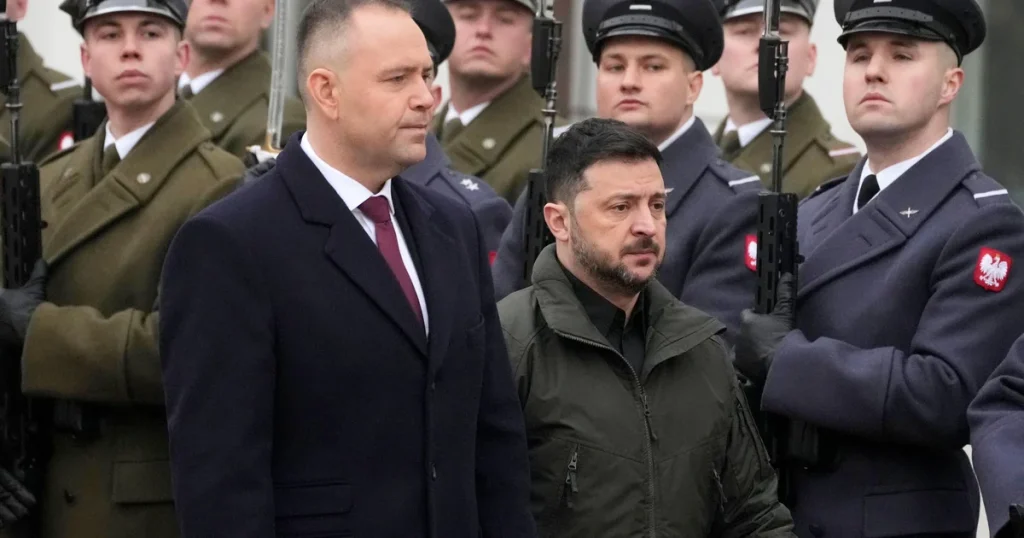
Zelenskyy Returns Poland’s Highest Honor Amid Historical Dispute
Zelenskyy returns Poland s highest honor – Volodymyr Zelenskyy, the leader of Ukraine, has returned the Order of the White Eagle, Poland’s highest state award, following a controversial decision by President Karol Nawrocki to revoke it. The move comes amid a heated debate over historical narratives surrounding World War II, with Nawrocki citing Zelenskyy’s recognition of a military unit linked to the Ukrainian Insurgent Army (UPA) as the primary cause. The Order, once a symbol of bilateral cooperation, was handed back to the Polish presidential office after a symbolic gesture that underscored the strained relationship between the two nations.
Historical Tensions and the Revocation
President Nawrocki’s decision to strip Zelenskyy of the honor was rooted in a disagreement over the UPA’s wartime actions. The UPA, a group that fought for Ukrainian independence in the 1940s and 1950s, is accused in Poland of orchestrating mass killings of Poles during the Nazi occupation. In a social media address, Nawrocki stated that the Ukrainian leader’s naming of a unit after the UPA was a “political act” that undermined the legacy of Polish victims. The president emphasized that the UPA’s role in wartime atrocities remains a central point of contention for many in Poland.
“For the majority of Polish society, the Ukrainian Insurgent Army remains above all a formation responsible for cruel crimes against the citizens of the Polish Republic during World War II,” Nawrocki declared in a 13-minute video post.
Zelenskyy, however, defended the decision, asserting that the honor was meant to honor the Ukrainian People and their military efforts. In a social media message, he wrote, “Today, I sent the Order back to the President of Poland. I believe the future will confirm the respect Ukrainians deserve.” The post included photos of the Polish award and a postal receipt showing its imminent delivery to the presidential office, highlighting the symbolic nature of the gesture.
The Context of the Dispute
The controversy began with Zelenskyy’s May 26 decree, which rebranded a unit of Ukraine’s Special Operations Forces after the UPA. The Ukrainian leader argued that the designation aimed to revive military traditions and acknowledge the unit’s role in safeguarding Ukraine’s territorial integrity. This decision sparked backlash in Poland, where the UPA is often viewed as a group responsible for wartime massacres. Critics pointed to the 2016 Polish Parliament resolution that labeled UPA actions as genocide, a classification that has fueled nationalist sentiments in the country.
Despite the political friction, Poland remains a crucial ally to Ukraine in its ongoing battle against Russia’s invasion. The nation has welcomed millions of Ukrainian refugees, and its support for Kyiv has been vital in maintaining international solidarity. However, Nawrocki, a nationalist politician, has been accused of leveraging anti-Ukrainian sentiment to bolster his political standing. His administration’s actions have intensified scrutiny over the treatment of Ukrainians in Poland, who have faced rising prejudice even as they contribute significantly to the local economy.
Reactions and Implications
Zelenskyy’s return of the award was met with mixed reactions. Kyrylo Budanov, head of the Ukrainian Presidential Office, called Nawrocki’s decision an “unfriendly act toward our people” and a “gift to the Moscow aggressor.” Budanov argued that the move would be used by Russia to deepen divisions between Ukraine and its Western allies. Meanwhile, some Ukrainian officials, including Budanov, announced plans to return other Polish honors they had received, signaling a broader shift in diplomatic posture.
Not all in Ukraine supported the return of the honor. Arseniy Yatsenyuk, a former prime minister, criticized the move, stating that “one harmful and incorrect decision by the current president of Poland cannot be corrected by other incorrect decisions of ours.” This sentiment reflects the complexity of the issue, as both nations navigate their shared history while striving for mutual respect in contemporary geopolitics.
Poland and Ukraine had previously made strides toward reconciliation, particularly in the exhumation of Polish victims. A December 2023 meeting between the two leaders in Warsaw had signaled progress on resolving historical grievances. Yet, the recent revocation of the Order has cast doubt on these efforts. Polish Prime Minister Donald Tusk, a political rival of Nawrocki, urged calm, stating on social media, “The front line runs elsewhere.” Tusk added that the dispute between the two countries “delights Putin and shocks our allies,” emphasizing the broader implications for international relations.
UPA’s Role in WWII
The UPA’s wartime activities are central to the current dispute. While the group fought against both Nazi Germany and the Soviet Union, its actions in the Volhynia and Eastern Galicia regions are seen by Poland as a campaign of ethnic cleansing. Historical records indicate that the UPA was responsible for the deaths of tens of thousands of Poles, often in retaliation for Soviet policies. These events have shaped Poland’s view of the UPA as a symbol of wartime aggression, contrasting with Ukraine’s perspective that the group was a legitimate resistance force.
Zelenskyy’s team contends that the UPA and Polish underground forces were engaged in a complex conflict, with both sides committing atrocities. The Ukrainian leader’s decree was framed as an effort to honor the unit’s contributions to national defense, rather than to glorify the UPA’s past actions. This nuanced stance highlights the ongoing debate over how to reconcile historical grievances with present-day alliances.
Future Prospects and Bilateral Relations
Despite the revocation, Nawrocki assured that Poland’s support for Ukraine would not waver. The decision to strip the honor was presented as a symbolic gesture rather than a rejection of Ukraine’s overall strategic importance. Zelenskyy, in his social media post, expressed gratitude for Poland’s continued backing while emphasizing the need for historical clarity. “I am proud of our people and of EVERY Ukrainian warrior,” he wrote, underscoring his resolve to defend Ukraine’s legacy.
Poland is set to host a major event on Ukraine’s postwar reconstruction next week, a meeting Zelenskyy had anticipated attending. The event represents an opportunity to address lingering tensions and reaffirm partnership. However, the timing of the revocation has raised questions about whether the dispute will hinder collaborative efforts. As the conflict over historical narratives continues, both nations must balance their respective perspectives while maintaining the fragile alliance that has been critical to Ukraine’s survival in the face of Russian aggression.
The incident underscores the challenges of navigating historical disputes in modern diplomacy. While the Order of the White Eagle is a prestigious award, its revocation has become a flashpoint for broader ideological differences. For Poland, the honor symbolizes recognition of its wartime sacrifices, while for Ukraine, it represents the enduring struggle for national identity. The resolution of this issue will likely depend on future dialogues that bridge the gap between historical memory and current political priorities.