
Newsom declares state of emergency in Los Angeles for Boyle Heights warehouse fire
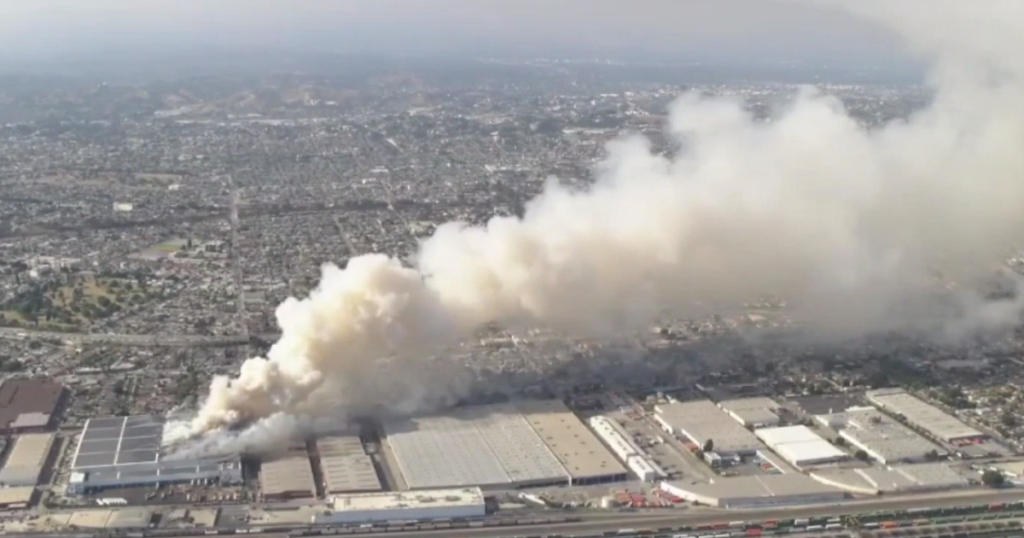
Newsom Declares State of Emergency Over Boyle Heights Warehouse Fire
Newsom declares state of emergency in Los – Governor Gavin Newsom has declared a state of emergency in Los Angeles following a massive warehouse fire in Boyle Heights. The blaze, which broke out at a cold storage facility on Wednesday, has forced authorities to ramp up efforts to contain the situation. Newsom’s emergency declaration aims to streamline resources and coordinate response teams, including the Los Angeles Fire Department (LAFD) and local officials. The fire, now in its third day, has created complex challenges for firefighters due to the building’s unique design and the extensive frozen goods stored inside.
Building Design and Fire Behavior
The Lineage Big Bear warehouse, located at 1400 S. Los Palos Street, is a 500,000-square-foot structure with corrugated steel walls and dense foam insulation. Firefighters described it as a “giant cooler,” highlighting how its construction could intensify the blaze. The refrigeration system, which uses ammonia to maintain freezing temperatures, may have contributed to the fire’s persistence, according to LA Fire Chief Jamie Moore. This unique combination of materials and systems has made the fire’s progression more difficult to predict and control.
“The best way to describe this is like a giant cooler,” said LA Fire Chief Jamie Moore. “The structure was built with corrugated steel walls filled with dense foam insulation and reinforced interior steel panels.”
Moore emphasized that the building’s layered insulation acts as a barrier, much like a refrigerator, trapping heat and slowing the spread of flames. “Imagine your refrigerator having a fire. And so, you have the shell of the outside and the shell on the inside,” he explained. “What protects everything from the weather, or whatever the temperature is on the outside, is the rubber. … If you can imagine, that’s exactly what’s happening here.” This analogy has helped clarify the fire’s behavior to the public, though the real challenge lies in managing the aftermath.
Firefighting Efforts and Resource Mobilization
To tackle the blaze, LAFD crews have deployed water-dropping helicopters and large aerial ladder pipes. These tools are critical in delivering thousands of gallons of water per minute to cool the structure and suppress the fire. Newsom’s emergency declaration has allowed for the coordination of additional resources, including contract helicopters that can transport up to 3,000 gallons of water each. Moore noted that the use of fire-retardant gel further aids in smothering the flames and reducing smoke.
Despite these efforts, the internal conditions of the building remain volatile. The unaffected section, still filled with frozen food, has seen temperatures rise as refrigeration systems were shut down to prevent the fire from spreading. “All that food is slowly beginning to rot. It’s no longer frozen. It’s warming up and it’s going to start to spoil,” Moore warned. The combination of heat and thawing goods now poses a dual threat: the fire and a potential biohazard.
Firefighters have had to rely on aerial methods to navigate the thick smoke and limited visibility. The initial assumption about the contents of the building was incorrect, as the facility houses a variety of meat products. “Initially it was reported to us that the majority of that product was bread and wheat products. However, we’re slowly learning as we get into this building that it’s far from that; there’s a lot of meat products,” Moore explained. This discovery has shifted the focus of the operation to both extinguishing the fire and salvaging the remaining stock.
Community Impact and Response Coordination
Newsom’s state of emergency declaration has also prompted broader community efforts. Residents in nearby neighborhoods have been advised to stay indoors due to the smoke advisory, while local businesses have reported disruptions from the firefighting operations. The declaration has enabled officials to allocate resources more efficiently, ensuring that both fire suppression and recovery efforts receive the necessary attention. Mayor Karen Bass has been working alongside Newsom to manage the crisis, emphasizing the need for a coordinated response to protect public safety and minimize economic damage.
The