
Venezuela’s Acting President Defends Sovereignty Amid Trump’s 51st State Claim
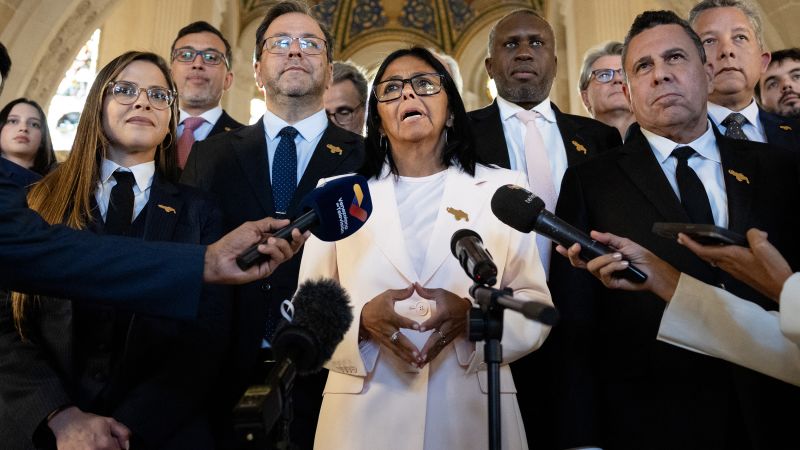
Venezuela s acting president defends country – Venezuela’s acting president has emphasized the nation’s commitment to its territorial integrity, countering former President Donald Trump’s suggestion that the country could become the 51st U.S. state. Delcy Rodríguez, who assumed leadership in January following a U.S. military operation, addressed journalists Monday, underscoring that Venezuela remains a sovereign state. Her remarks came during final discussions at the International Court of Justice in The Hague, where Venezuela and Guyana are contesting ownership of the Essequibo region, a landmass of immense strategic and economic value.
Essequibo Dispute: A Battle for National Identity
The Essequibo region, spanning 62,000 square miles, represents two-thirds of Guyana’s territory and is rich in natural resources, including oil, gold, and diamonds. Venezuela’s claim to the area dates back to colonial times, with the 1899 arbitration between Britain, Russia, and the U.S. establishing the current border along the Essequibo River. However, the acting president argued that the 1966 Geneva agreement, which aimed to resolve the dispute through dialogue, should take precedence over judicial proceedings. “We will protect our national pride and economic assets,” Rodríguez stated, highlighting the region’s significance to Venezuela’s future.
“Venezuela is not a colony, but a free nation with the right to defend its land,” declared Rodríguez, who has prioritized diplomatic efforts to assert the country’s position. Her speech at the International Court of Justice reflected a broader strategy to challenge Guyana’s recent move to escalate the legal battle, which she viewed as a political maneuver rather than a genuine attempt to settle the dispute. The acting president also linked the Essequibo claim to Venezuela’s oil discoveries, framing the territory as a vital asset for national development and international influence.
Trump’s Comments and Geopolitical Repercussions
During a Fox News interview, Trump hinted at the possibility of annexing Venezuela, a statement that has reignited discussions about U.S. involvement in the country’s affairs. While the exact context of the remark remains unclear, it has prompted Venezuela’s acting president to reaffirm her nation’s independence. “The U.S. has long sought to exert influence over Venezuela’s sovereignty,” she noted, citing historical tensions and recent geopolitical shifts. The comments have also drawn criticism from Guyana’s foreign minister, who accused the U.S. of prioritizing its own interests over the region’s stability.
Venezuela’s stance is further reinforced by its historical narrative, with Rodríguez pointing to the 1966 Geneva agreement as a key document in the dispute. The acting president argued that Guyana’s decision to take the case to the International Court of Justice was opportunistic, leveraging the region’s newfound oil reserves to bolster its claim. This move, she said, undermines the spirit of the 1966 pact, which Venezuela maintains should serve as the foundation for resolving the conflict through diplomatic means.
The dispute has deepened as Maduro’s predecessor, who was ousted in January, had previously threatened to annex the Essequibo region after a 2023 referendum. Now, under Rodríguez’s leadership, Venezuela is doubling down on legal and political arguments to assert its position. “Our goal is to protect Venezuela’s sovereignty and ensure its rightful place in the international community,” she emphasized, framing the case as a fight for national dignity and economic security.
Despite the tension, the acting president has expressed openness to continued dialogue with the U.S. and Guyana. “Venezuela’s interests are not tied to any single nation, but to its people and its future,” she said. Her approach contrasts with Trump’s more assertive remarks, which have sparked debates about the potential for U.S. intervention in Venezuela’s affairs. As the International Court of Justice deliberates, the outcome could shape the country’s geopolitical standing and its ability to safeguard its territorial claims.





