
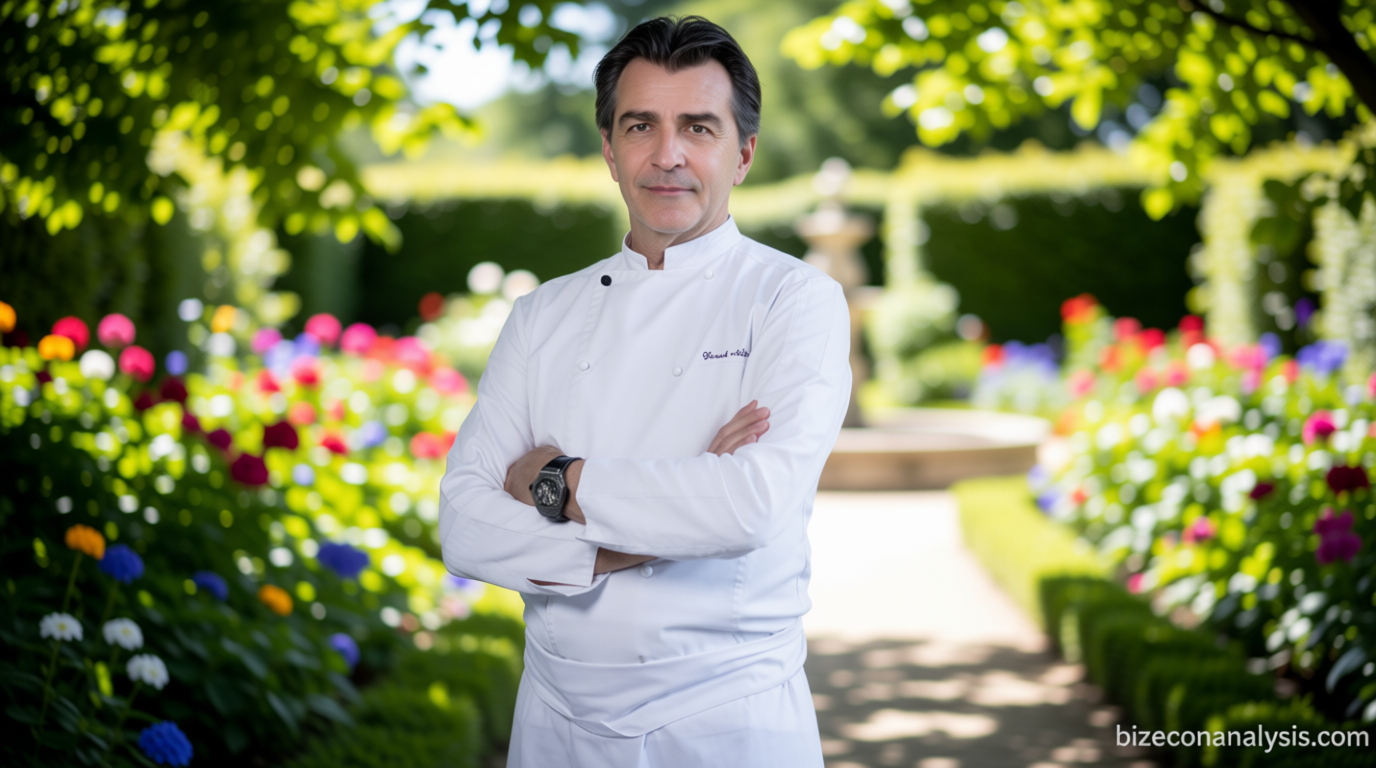
The Chef with 18 Michelin Stars Who’s Still Largely Undiscovered Outside of France
The chef with 18 Michelin stars – Yannick Alléno, a culinary virtuoso with an impressive tally of 18 Michelin stars across 21 restaurants, has remained a household name primarily within France. While his reputation in the country is firmly established, his global recognition has yet to match the acclaim he has earned locally. This paradox has sparked curiosity among food enthusiasts and critics, who wonder why such a decorated chef has not yet broken into international prominence.
Though Alléno’s influence spans multiple continents, his roots are deeply embedded in the cultural heart of Paris. The city’s prestigious Pavillon Ledoyen, a historic venue nestled behind the Petit Palais where masterpieces by Rembrandt, Gauguin, and Cézanne line the walls, has played a pivotal role in his career. This Neoclassical building, adorned with buttercream and forest green facades, has hosted notable figures since its founding in 1792, including artists and writers like Monet, Degas, and Zola. Some even believe Napoleon Bonaparte and Joséphine de Beauharnais first shared a moment here before it transformed into a dining establishment.
Alléno’s journey began in the shadow of Parisian gastronomy, where he carved his path through the fine dining kitchens of the French capital. His first Michelin star came in 2000 at Scribe, a restaurant that later became a cornerstone of his early achievements. By the time he took over as head chef at the Pavillon Ledoyen in 2014, he had already amassed six stars, three at Le Meurice, one of Paris’ legendary palace hotels, and three at Le 1947 à Cheval Blanc in the alpine ski resort of Courchevel. His tenure at the Pavillon Ledoyen was marked by a swift rise to prominence, as his eponymous restaurant, Alléno Paris, received its first three-star rating just seven months after opening.
Despite his stellar reputation, Alléno’s global reach has been limited compared to his domestic impact. His family’s culinary legacy, rooted in the bustling bistro of his parents, provided the foundation for his passion. “It was thanks to them that I was inspired to pursue this career,” he reflects in a
interview with CNN Travel. “They shaped the early flavors of my imagination.”
His grandmother and cousins further enriched this environment, infusing it with a blend of tradition and creativity that would later define his approach to cooking.
As the head of the Pavillon Ledoyen, Alléno has not only preserved the building’s heritage but also elevated its status through innovative techniques. Diners at the restaurant now pay over 330 euros for a meal in its sunlit, historic dining room—a testament to the exclusivity of the experience. In addition to the main venue, Alléno has expanded the site’s culinary offerings with two other establishments: L’Abysse Paris, a two-star Franco-Japanese restaurant, and Pavyllon Paris, which holds a single star. This portfolio showcases his ability to blend diverse culinary traditions, creating a unique identity within the Parisian food scene.
His ambition extends beyond France, with a growing presence in locations such as Monaco, Dubai, the United Kingdom, Japan, the UAE, South Korea, and Qatar. Even in his new ventures, such as the Michelin-starred breakfast menu at Pavyllon London, located at the Four Seasons Hotel, Alléno maintains a consistent standard of excellence. The recognition of his work in these international markets has brought him closer to the global spotlight, yet he remains largely unknown outside of his native country.
Alléno’s culinary philosophy is centered on redefining the essence of French cuisine. He views Michelin stars as a validation of his methods, particularly his reinvention of sauces. “For me, the stars are a proof of concept,” he explains. “They show that the reforms I’ve undertaken are effective.” This perspective is rooted in his belief that French cuisine should evolve beyond the 19th-century foundations laid by Auguste Escoffier. While Escoffier’s system of classical cooking established the framework for modern French gastronomy, the rise of nouvelle cuisine in the 1970s diminished the prominence of the Saucier role—once one of the most revered positions in a kitchen.
Alléno has revived this forgotten craft, using cutting-edge techniques to distill flavors into their purest form. He calls this process “extractions,” a method that involves dehydration, fermentation, and cryoconcentration to transform ingredients into concentrated, liquid versions of their essence. This approach allows him to create cohesive dishes by harmonizing seemingly disparate elements like beef fillet and asparagus, bridging the gap between traditional and contemporary cuisine.
His work has not gone unnoticed. In 2026, the Michelin Guide France & Monaco ceremony awarded Monsieur Dior, his restaurant housed in the Parisian building where the fashion house Dior was founded, its first star. This milestone pushed his total Michelin star count to 18, placing him alongside Alain Ducasse as one of the most decorated chefs in the world. Yet, the question remains: why hasn’t this global acclaim translated into widespread recognition?
Some attribute this to the nature of haute cuisine itself, which often remains an exclusive domain for those within its cultural and geographic boundaries. Fast food consumption, meanwhile, continues to surge in the heart of this traditional culinary landscape. Alléno’s success, however, challenges this trend. His ability to innovate while respecting tradition has allowed him to maintain a balance between accessibility and refinement. The Pavillon Ledoyen, for instance, offers a menu that is both elevated and approachable, ensuring that his creations remain relevant in an era of changing dining habits.
His early life in the suburbs outside central Paris informs his perspective on the culinary world. “I come from a big family, one of those families that feels out of the novels we romanticize today,” he says. “We were always cooking, and the kitchen was our common language.” This upbringing, combined with his training under traditional French chefs—many of whom hold the prestigious Meilleurs Ouvriers de France title—has given him a unique blend of heritage and modernity. His work at the Pavillon Ledoyen and other restaurants reflects this fusion, blending the time-honored techniques of the past with contemporary creativity.
Alléno’s dedication to sauces, which he refers to as “the verbs of French cuisine,” underscores his commitment to reimagining the language of food. By focusing on this element, he has transformed it into a tool for innovation, ensuring that even the most complex flavors are expressed with clarity and precision. This philosophy has earned him both critical acclaim and a loyal following, but it also highlights the challenge of standing out in a world where culinary excellence is abundant.
As he continues to expand his influence, Alléno’s journey serves as a reminder of the power of tradition and the importance of reinvention. While his Michelin stars may be a measure of his success, his true impact lies in the way he bridges the gap between the past and the present, ensuring that French cuisine remains a dynamic and evolving art form. For now, the world outside France may not yet know his name, but his contributions to gastronomy are undeniably shaping the future of the craft.





