
Saying ‘Screw You’ Through Architecture: America’s Spite Houses
Saying screw you through architecture – Aaron Jackson’s journey began with a casual exploration on Google Earth. Living in New York City and working at a nonprofit, he found himself in a moment of reflection after Superstorm Sandy struck in 2012. Trapped in his small Queens apartment, he spent hours online, diving into digital rabbit holes. It was during this time he stumbled upon the Westboro Baptist Church (WBC), a group labeled as a hate organization by the Southern Poverty Law Center. Known for their provocative protests at soldiers’ funerals and their anti-LGBTQ+ slogans, the WBC became the focus of Jackson’s attention. One day, while scrolling through satellite images, he noticed a “for sale” sign near the church’s property. The sight sparked a thought: “What if I bought that house?”
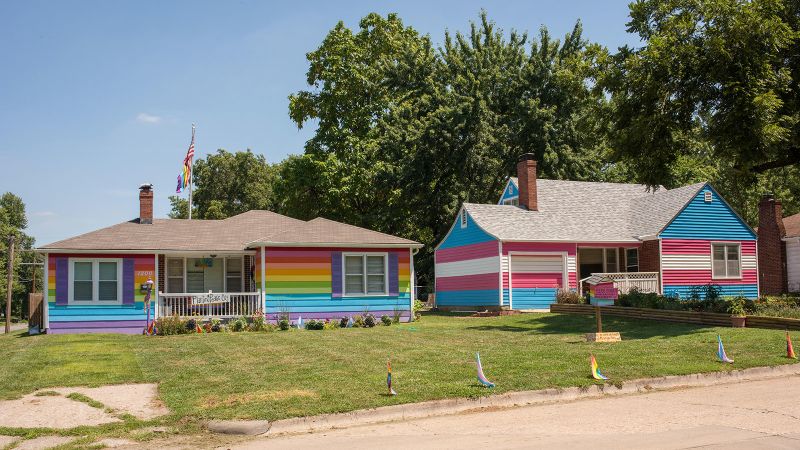
Though the specific home in Topeka, Kansas, was already sold by the time Jackson inquired, another on the same street was available. With no prior visit, he decided to proceed with the purchase. The move marked a personal transformation. Jackson, who described himself as a “news junkie,” embraced the new location, relocating to the state capital. But his intention went beyond mere relocation. He aimed to confront the WBC’s ideology by transforming his property into a bold statement of defiance. The house, now known as the Equality House, was painted in rainbow hues to mirror the Pride flag, a deliberate act meant to challenge the church’s anti-gay rhetoric. Its placement directly across from the WBC’s residence ensured it could not be overlooked.
“The Equality House is a symbol of compassion, peace, and positive change,” reads a statement on the Planting Peace website, the nonprofit Jackson founded. Yet, the house’s nickname as a “spite house” has sparked debate. While Jackson doesn’t use the term himself, many argue that its purpose was to irritate the WBC. The concept of spite architecture, though relatively new, has roots in American history. It refers to structures built to annoy specific individuals or groups, often with a sense of malice. Unlike “nail houses,” where owners refuse to sell to developers, spite houses are constructed with the intent to provoke.
One of the most iconic examples of spite architecture is Boston’s “Skinny House.” Located in the historic North End, this ten-foot-wide, four-story structure rises defiantly above its neighbors. According to a real estate agent, the house was built by two brothers. One constructed a grand mansion for himself while the other was away fighting in the Civil War. When the soldier returned, furious at the smaller share of land his brother had been given, he erected a narrow tower to block sunlight and views from the larger home. Today, the property is marked with a plaque that reads “Skinny House” (Spite House in parentheses), and it has become a tourist hotspot in the neighborhood, home to landmarks like the Old North Church and a Paul Revere statue.
While the Skinny House is a classic case, modern examples often reflect contemporary tensions. Jackson’s Equality House, for instance, was not just a physical space but a cultural statement. Its vibrant colors, visible from the WBC’s windows, were designed to provoke and inspire. The home’s strategic location on a major highway—Interstate 70—made it a natural focal point for visitors. Topeka’s population of around 125,000 and its role as a transit hub for road trippers amplified the house’s visibility. Despite its small size, the Equality House sold for $1.25 million in 2021, a testament to its symbolic value.
John Doe, a local real estate agent, remarked on the house’s unique appeal. “It’s not just a home—it’s a conversation starter.” The property became a canvas for social media engagement, with tourists posing in front of it, often stretching their arms between the house and its neighbor. Jackson’s second purchase on the same street, painted in pink, white, and blue to represent the trans pride flag, further expanded the message. These homes, though privately owned, have transformed into public symbols of resistance.
The debate around hostile architecture continues to evolve. While some view it as a tool for exclusion, others see it as a form of artistic expression. In the case of Jackson’s homes, the tension is clear: a modest structure built to challenge a vocal minority. The WBC, with its history of aggressive activism, has made the neighborhood a battleground for ideology. The Equality House, however, stands as a counterpoint, embodying the spirit of inclusion.
Hostile architecture is not confined to the United States, but it has found a particularly fertile ground here. The country’s deep-rooted individualism and strong emphasis on private property make it ideal for such acts. A spite house is not merely a building; it’s a declaration of intent. Whether it’s a narrow tower blocking sunlight or a rainbow-colored home disrupting a church’s view, the message is unmistakable. These structures are designed to be seen, to provoke, and to persist.
As cities grow and spaces become more contested, the role of architecture in shaping social dynamics grows more pronounced. Jackson’s work highlights how a single house can become a symbol of broader movements. The Equality House, now part of a larger nonprofit initiative, has also launched orphanages and elephant rescue programs, demonstrating that spite architecture can serve multiple purposes. It can be a statement of defiance, a platform for activism, and a catalyst for community engagement.
In the end, the story of the Equality House is not just about a house in Topeka. It’s about the power of design to challenge norms and spark dialogue. As the sun sets over the property, the colors still shimmer, a reminder of the struggle between hate and hope. The debate over whether these homes are acts of hostility or symbols of compassion will likely continue, but one thing is certain: they are here to stay, a testament to the enduring impact of architecture on our shared spaces.





