
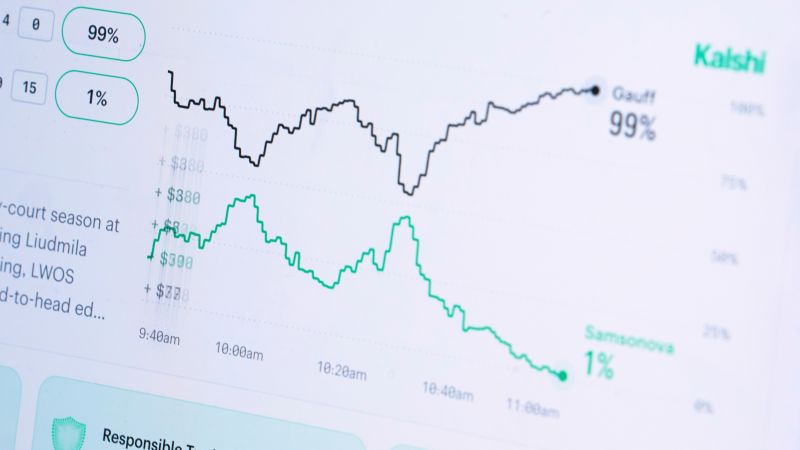
What are prediction markets and why is the Trump administration on board?
What are prediction markets and why is – Each week, billions of dollars flow through prediction markets, platforms that are gaining rapid traction and enable users to wager on real-world events spanning sports, politics, and pop culture. These markets operate on the premise of betting on outcomes, such as whether a particular event will occur by a specific date or if a political figure will make a specific statement. While their structure resembles gambling, the Trump administration has shown strong support for these companies, aligning with the broader industry’s push to legitimize their role in the financial ecosystem. Meanwhile, the Trump family has also positioned itself to benefit from this growing market, seeking to capitalize on its potential.
The Mechanics of Prediction Markets
At the core of these markets is the concept of an “event contract,” where participants take a position on a binary outcome—yes or no—and allocate funds accordingly. For instance, if a market assigns a 25% probability to an event, individuals can invest 25 cents to secure a payout of $1 if the outcome is correct. This system mirrors traditional financial instruments, such as futures contracts, which have long been used by farmers to mitigate risks associated with crop yields. However, the distinction between prediction markets and conventional trading remains a point of contention, particularly among state regulators.
“Prediction markets give you a chance to bet on almost anything, in the sense that markets will go up, typically around a yes-or-no question. Will something happen by X date? Will Trump say X, Y or Z? Will this person win an election? Will the Lakers win their game tonight? When will Taylor Swift’s next album come out? Anything,”
Senior CNN reporter Marshall Cohen, who specializes in prediction markets, explained their function and the broader implications of their classification. “The market is structured as an event contract where you take a position, yes or no, and put your money behind it. If something has a 25% chance of happening, you can buy a share of ‘yes’ for 25 cents, and get paid out the full $1 if you’re right. (Minus some fees.) You make money if you bet correctly; you lose your money if you were wrong,”
This framework, Cohen noted, blurs the lines between speculative betting and financial risk management. While some states view prediction markets as a form of gambling, others argue they are essential tools for assessing probabilities and managing uncertainty. The Trump administration has consistently defended their classification as financial instruments, a stance that resonates with industry advocates. However, the legal battle between federal regulators and state governments has intensified, with over 40 states challenging the industry’s status.
The Legal Showdown
The dispute centers on whether prediction markets should be regulated as gambling or as derivative swaps, a type of financial contract. Companies like Kalshi, which operate these platforms, claim that their models are analogous to commodity trading, where farmers hedge against risks like poor corn harvests. The argument hinges on the idea that prediction markets serve the public interest by allowing individuals to mitigate risk, much like traditional futures markets. Yet, critics, including 40 states, contend that these markets lack the tangible assets of commodity trading and instead resemble pure gambling.
For example, a state resident might use Kalshi to bet on the outcome of a sports game or a political election, similar to how a casino patron might place a bet. This similarity has drawn comparisons to the casino industry, which has long resisted regulation. The Trump administration, alongside Kalshi, has advocated for a deregulatory approach, emphasizing the benefits of market-driven forecasting. However, the legal battle has reached a critical juncture, with states filing briefs in court to assert their position.
“Supporters argue that the purpose of these financial markets is rooted in the commodity trading that has existed for a very long time in this country, that farmers have used to hedge their risk for a bad crop season, corn futures, soybean futures, etc. Technically and legally speaking, prediction markets are set up in the same way,”
This argument underscores the industry’s claim that prediction markets are not merely speculative ventures but are integral to economic decision-making. Yet, the line between risk hedging and gambling remains ambiguous, especially when considering high-stakes bets on events like presidential elections. The case of a special operations soldier who allegedly used classified information to profit over $400,000 highlights the potential for manipulation within these markets. The soldier’s bets, which included predicting the removal of Venezuelan President Nicolás Maduro, were timed to coincide with his capture by U.S. forces, raising questions about insider trading and market integrity.
State Perspectives and Industry Advocacy
The legal conflict has created a divide among states, with a coalition spanning from liberal progressive states like Oregon and California to conservative strongholds such as Alabama and Mississippi. These states argue that prediction markets, particularly those involving political events, pose risks to democratic processes and should be subject to stricter oversight. Meanwhile, the Trump administration has consistently backed the industry, advocating for its classification as financial markets rather than gambling operations.
Cohen pointed out that the distinction is often a matter of perspective. “If you want to pull up the same Eagles/Cowboys game on DraftKings, but you’re in a state where it’s illegal because they don’t allow sports betting, you can just switch over to Kalshi and trade on that game on a prediction market. It’s pretty indistinguishable for the end user,”
This scenario illustrates how prediction markets can function as alternatives to regulated gambling, providing flexibility for participants. However, it also underscores the industry’s growing influence and the challenges states face in maintaining control. The Biden administration, in contrast, has taken a more cautious approach, attempting to classify prediction markets as gambling in certain contexts. In 2024, the CFTC proposed a rule to ban sports and election-related betting, aiming to safeguard democratic integrity and prevent speculative risks from overshadowing traditional financial derivatives.
While the Biden team argued that sports betting was already covered by federal regulations, the election-focused portion of the industry was seen as a threat to the fairness of democratic systems. The administration contended that prediction markets, unlike commodity futures, did not provide clear economic value and were more akin to speculative gambling. This approach, however, faced criticism from industry proponents, who emphasized the utility of market-driven insights in predicting real-world outcomes.
Despite the administration’s efforts, the rule was not finalized before the election, leaving the legal status of prediction markets in limbo. The Trump administration’s support has since shifted the balance, with a clear mandate to prioritize the industry’s growth. As the debate continues, the outcome of this legal showdown could shape the future of prediction markets, determining whether they are viewed as economic tools or gambling ventures. The stakes are high, and the implications extend beyond finance, touching on the very nature of risk assessment and market participation in the digital age.





