
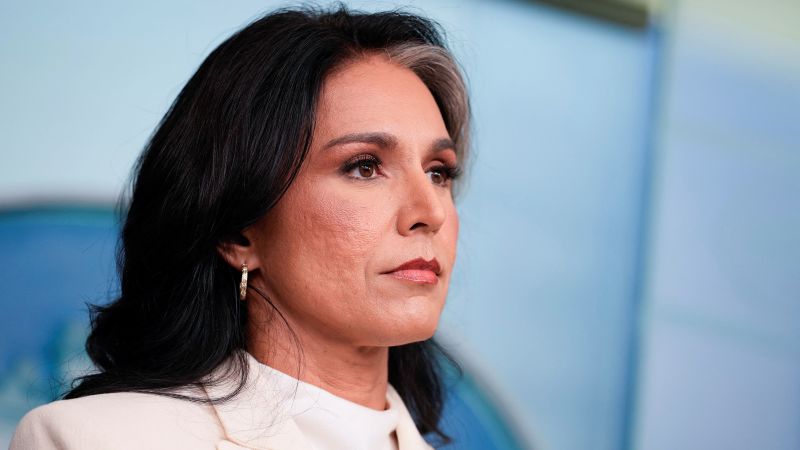
Tulsi Gabbard is resigning as director of national intelligence
Tulsi Gabbard is resigning as director – Tulsi Gabbard, the director of national intelligence, has announced her decision to step down from the role, effective June 30, 2026. In a letter addressed to President Donald Trump, she outlined the reason for her departure, citing her husband’s recent diagnosis with a rare form of bone cancer. “Unfortunately, I must submit my resignation, effective June 30, 2026,” she wrote, adding that her husband, Abraham, has been identified with an uncommon type of bone cancer. The illness presents significant challenges for him in the coming weeks and months, prompting Gabbard to seek a temporary leave from public service to support him during this critical period.
President Trump responded swiftly to Gabbard’s announcement, expressing admiration for her commitment to her family. In a post on Truth Social, he acknowledged her efforts, stating, “Her wonderful husband, Abraham, has been recently diagnosed with a rare form of bone cancer, and she, rightfully, wants to be with him, bringing him back to good health as they currently fight a tough battle together.” He further praised her contributions, saying, “She has done an incredible job, and we will miss her.” The transition to an acting director is already underway, with Principal Deputy Director of National Intelligence Aaron Lukas set to assume the role.
Gabbard’s resignation follows a period of speculation within the White House about her future. Rumors of her intent to leave had circulated for several weeks, though she denied these claims until two weeks prior. A senior administration official confirmed that the decision was made after careful consideration, emphasizing that her focus has shifted to prioritizing her husband’s care. “My husband, Abraham, has recently been diagnosed with an extremely rare form of bone cancer. He faces major challenges in the coming weeks and months. At this time, I must step away from public service to be by his side and fully support him through this battle,” she wrote in the letter.
“Abraham has been my rock throughout our eleven years of marriage — standing steadfast through my deployment to East Africa on a Joint Special Operations mission, multiple political campaigns, and now my service in this role. His strength and love have sustained me through every challenge. I cannot in good conscience ask him to face this fight alone while I continue in this demanding and time-consuming position.”
Her tenure as director has not been without controversy. Critics have pointed to inconsistencies in her public statements, especially regarding the U.S. conflict with Iran. These contradictions sometimes placed her at odds with the White House, leading to tensions during her time in the role. Gabbard’s resignation marks her as the latest Cabinet member to depart from the administration, joining a list that includes Homeland Security Secretary Kristi Noem and Attorney General Pam Bondi.
Gabbard’s background is as distinctive as her political trajectory. A former Democratic congresswoman who represented Hawaii’s 2nd Congressional District, she made history as the first American Samoan and practicing Hindu individual to serve in Congress. Her military service also stands out, having been recognized as an Iraq War veteran. However, her political affiliations have evolved significantly since her time in the House. She initially ran for president as a Democrat in 2020, positioning herself as an anti-interventionist with a focus on foreign policy. Two years later, she left the Democratic Party, a move that drew attention due to her shifting alignment.
Despite her departure from the Democratic Party, Gabbard continued to play a role in the 2024 presidential race. She endorsed Donald Trump and participated in his campaign, including debates against then-Vice President Kamala Harris. Her transition to the Republican Party occurred before the election, and she became part of Trump’s transition team following his victory. This appointment led to her selection as director of national intelligence, a position that oversees 18 intelligence agencies and serves as a critical link between the executive branch and the intelligence community.
Gabbard’s career has been marked by a blend of military service, political activism, and a unique approach to governance. Her time in the Army Reserves highlights her dedication to national security, a theme that resonates throughout her public service. The decision to resign, however, underscores the personal sacrifices required in high-profile roles. As she transitions out of the DNI position, her focus will shift to her husband’s health, a priority she has emphasized in her communication to Trump.
Her departure also raises questions about the administration’s internal dynamics and the challenges of balancing personal obligations with public responsibilities. While Gabbard’s resignation is a notable event, it is part of a broader pattern of leadership changes under Trump. The timing of her exit, shortly after the announcement of other departures, adds to the narrative of a leadership reshuffle. Nonetheless, her contributions to intelligence policy and her advocacy for a foreign policy approach rooted in pragmatism will remain part of her legacy.
The story has been updated with additional details, reflecting the ongoing developments in Gabbard’s career and the impact of her decision. As she prepares to step down, the intelligence community and the White House will navigate the transition, ensuring continuity in national security efforts. Gabbard’s journey from a Hawaii congresswoman to a key Cabinet member illustrates the evolving nature of political careers and the personal factors that can influence major decisions. Her story serves as a reminder of the interplay between public service and personal life, highlighting the challenges faced by leaders in high-stakes roles.





