
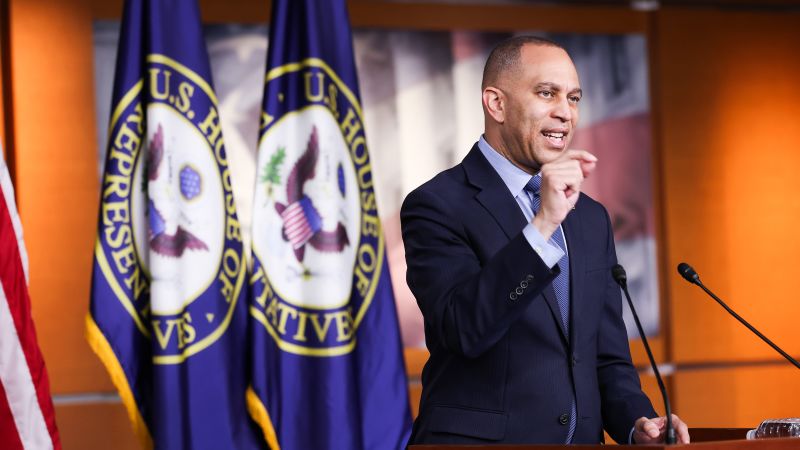
Hakeem Jeffries Wants to Redraw House Maps from Oregon to New York. He’s Willing to Take on Democrats to Do It
Hakeem Jeffries wants to redraw House – After a prolonged battle with the GOP over redistricting, the Democratic Party found itself in a precarious position as recent judicial decisions threatened to undo its progress. The past 10 months had seen top Democrats revise their traditional strategies, engaging in intense negotiations with Republicans to reshape congressional districts. Yet, just 13 days after these efforts, a pair of court rulings—one from the US Supreme Court and another from Virginia—pulled the rug out from under their ambitions, costing them up to 10 seats and leaving the party scrambling to respond in a nationwide race for electoral advantage.
At the heart of this crisis is House Minority Leader Hakeem Jeffries, whose leadership has driven Democrats to adopt more aggressive tactics in the redistricting war that began with President Donald Trump’s 2022 campaign. Jeffries and his allies are now crafting a two-year strategy to ensure Democratic-controlled states prioritize partisan gains, potentially sacrificing nonpartisan principles in the process. According to sources, the plan aims to secure a dozen or more new Democratic-held seats by November 2028, with a particular focus on battlegrounds stretching from Oregon to New York. This effort is expected to require additional funding in the hundreds of millions, as the party prepares to outmaneuver Republicans in states where they previously held sway.
Jeffries has emphasized the urgency of this shift, declaring to CNN that “the days of Democrats unilaterally disarming are over, particularly given how high the stakes are.” His message signals a willingness to challenge even fellow Democrats who may resist the increasingly polarizing tactics of gerrymandering. Behind the scenes, his allies are already mobilizing to target internal dissent, with some suggesting that members who oppose aggressive redistricting could face political pressure, including primary challenges, in the coming years.
The Courts’ Impact on Democratic Strategy
The recent rulings have forced Democrats to confront a stark reality: their dominance in redistricting is now under threat. The US Supreme Court’s decision, along with the Virginia Supreme Court’s invalidation of a Democratic-led referendum, has left the party’s plans in disarray. In Virginia, the ruling struck down a proposal that could have added as many as four seats to the Democratic majority, prompting lawmakers to brainstorm alternative strategies that might have seemed radical just weeks ago.
Among the ideas floated, one stood out as particularly contentious: replacing the entire state Supreme Court. This proposal, discussed in private meetings, was seen as a way to overturn the court’s decision and restore the previously approved map. However, Virginia Senate Majority Leader Scott Surovell, a Democrat, dismissed the notion, stating that the state’s chief justice, Cleo Powell, was the only dissenting voice in the court. “We just swore in the first Black female chief justice of the Supreme Court of Virginia in our 250-year history about three months ago, and to throw her out because her colleagues made a bad decision would be ill-advised,” Surovell explained to CNN.
Despite the setback, Jeffries remains undeterred. He has directed his team to focus on states where Democratic control is still uncertain, urging them to act “aggressively” to counter Republican advances. This includes targeting districts in New York, New Jersey, Washington, Colorado, Oregon, Maryland, and Illinois, with the hope of creating a wave of Democratic victories. Multiple party officials confirmed that additional states could join the list if Democrats win key races in November, further expanding their redistricting reach.
A Strategy of Intensity and Division
The Democratic strategy now hinges on a combination of financial investment, political maneuvering, and internal unity. Some lawmakers are already considering drastic measures, such as limiting speaking opportunities for blue-state leaders at the Democratic National Convention if they fail to support a new map. This reflects a growing frustration within the party, as the court rulings have exposed the vulnerability of their current redistricting framework.
Terri Sewell of Alabama, a prominent advocate for partisan gerrymandering, has openly called for a “clean sweep” in states where Republicans currently hold seats. “I would take 52 seats from California, I sure would,” she remarked to reporters, adding, “and 17 from Illinois.” Her comments underscore the party’s determination to leverage redistricting as a tool to consolidate power, even if it means sidelining their own members who might prefer a more moderate approach.
While Jeffries’s push for aggressive redistricting has galvanized his allies, it has also sparked debate. Rep. Cleo Fields of Louisiana, whose district has been cleared for redrawing, acknowledged that the strategy could lead to a “race to the bottom” in electoral fairness. “It’s almost a race to the bottom,” he noted, “but Democrats in blue states have a responsibility to do something.” Fields admitted that the party’s traditional moral stance on gerrymandering might need to be reevaluated in the short term, as the need for results outweighs ideological purity.
Jeffries’s leadership has also intensified the focus on states where Democratic candidates are already in office. The idea of challenging sitting members who hesitate to embrace gerrymandering has gained traction, with some officials suggesting that primary battles could become a way to enforce party loyalty. This approach, while controversial, is seen as necessary to maintain the momentum of Democratic gains in the 2028 elections.
As the redistricting battle continues, the Democratic Party’s strategy is evolving to address both external and internal challenges. With the courts now on the sidelines, Jeffries and his allies are determined to reclaim control, even if it means taking on their own members to ensure the party’s survival in the face of a changing political landscape. The next two years will likely see a series of bold moves, as Democrats prepare to face the next phase of the congressional race.





