
Trump and Top CEOs Depart Beijing with Limited Progress Amid China’s Self-Reliance Push
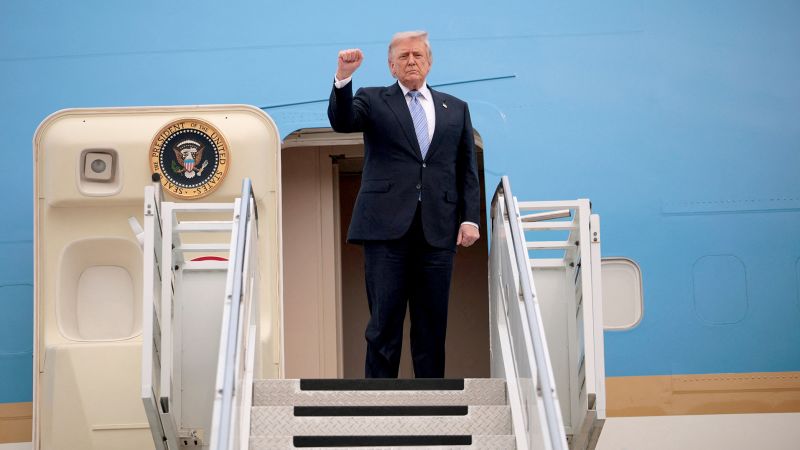
Trump and top CEOs leave a more – President Donald Trump concluded his two-day summit in Beijing with a mixture of optimism and ambiguity, claiming to have secured several trade agreements with China during his final press conference on Friday afternoon. Accompanied by a group of influential tech and business leaders, including NVIDIA’s Jensen Huang, Apple’s Tim Cook, and Tesla’s Elon Musk, Trump’s team left the meeting with few tangible outcomes to showcase. Analysts and market participants noted the lack of clarity around the deals, suggesting a potential shift in the power dynamics between the United States and China since Trump’s last visit nearly nine years ago.
Market Volatility Reflects Uncertainty
Investors reacted swiftly to the summit’s limited progress, with stock markets experiencing notable declines. The Dow Jones Industrial Average futures dropped over 300 points, a 0.6% fall, while the broader S&P 500 futures dipped 1% and Nasdaq futures fell 1.4%. These movements underscored the unease among traders, who viewed the absence of firm commitments as a sign of weakened US leverage. Meanwhile, Brent crude oil futures surged 3%, climbing above $108 per barrel, as concerns about the Strait of Hormuz remained unresolved. Soybean futures, however, suffered a sharp decline after the US hinted at China’s tentative promise to boost agricultural imports, though the specifics of that commitment remained unclear.
Bond yields also rose as traders grew cautious about inflationary pressures. This reaction highlighted the growing skepticism toward the US’s ability to secure favorable trade terms with China. The summit, which marked the first meeting between a US president and Chinese leader Xi Jinping in the capital since November 2017, had initially been scheduled for April. However, Trump delayed the event to address a critical energy crisis triggered by his decision to escalate tensions with Iran.
A Weaker US Hand at the Summit
Despite the summit’s high stakes, Trump arrived in Beijing with a relatively diminished position compared to China. This shift was attributed to the US’s domestic challenges, including soaring gas and consumer goods prices, which have fueled widespread discontent. Consumer sentiment has also hit historic lows, adding pressure on the administration to deliver results. In contrast, China’s leadership faces fewer immediate domestic pressures, allowing it to maintain a more strategic stance in negotiations.
On the final day of the summit, Trump announced that China would purchase 200 Boeing aircraft, a move he framed as a step toward strengthening economic ties. He also expressed interest in increasing US oil exports to China, citing the Middle East conflict as a factor disrupting global supply chains. Additionally, Trump indicated openness to lifting sanctions on Chinese firms that acquire Iranian oil, though no formal agreement was reached. US Trade Representative Jamieson Greer hinted at a broader commitment to buy agricultural products, stating the expectation was for “double-digit billions” in deals, but the exact figures were not disclosed.
China, however, has yet to confirm any of the US proposals. Analysts, who had already anticipated limited breakthroughs, emphasized the deteriorating state of US-China relations as a key factor in the summit’s modest outcomes. This contrasts sharply with the 2017 meeting, where the Trump administration unveiled a flurry of agreements, including a landmark deal for China to purchase 300 Boeing planes. That agreement, though ambitious, was never fully realized, leaving room for skepticism about the current summit’s potential.
The Evolving Role of Tech CEOs
The composition of Trump’s delegation this time around reflected a different focus compared to 2017. Instead of a large group of executives, the 17 attendees were primarily from technology and finance sectors, with prominent figures like Jensen Huang, Tim Cook, and Elon Musk playing central roles. Huang, who joined the trip at the last minute, has been advocating for US sales of its less advanced chips to China, a push that aligns with broader efforts to sustain tech exports. However, China has been hesitant to commit to these purchases, preferring to support its domestic semiconductor industry.
Tesla’s Musk faced similar challenges in securing a foothold in the Chinese electric vehicle (EV) market. Despite his presence, the company has lost ground to BYD, a leading Chinese EV manufacturer, both domestically and globally. Counterpoint Research reported that Tesla’s market share in China dropped to 10% in the fourth quarter of 2025, down from 14% the previous year. This decline mirrors the broader trend of Chinese firms gaining dominance in key industries, including EVs, where BYD surpassed Tesla as the world’s largest seller last year. The shift highlights China’s strategic investment in developing indigenous companies, reducing reliance on foreign technology and market access.
Apple’s Tim Cook also encountered resistance from Chinese smartphone giants like Huawei and Xiaomi. While Apple maintained a 22% market share in China as of late 2025, the company continues to rely heavily on Chinese manufacturing and assembly operations. The absence of new US investment pledges in the Chinese market has left these firms in a more vulnerable position, with Cook’s team seeking opportunities to strengthen their presence in a rapidly evolving sector.
Legacy of the 2017 Summit vs. Current Challenges
The 2017 summit, often cited as a turning point in US-China trade relations, saw nearly 30 executives from the US accompany Trump, aiming to secure specific export agreements. At that time, the Commerce Department highlighted 37 deals totaling over $250 billion, including a significant commitment for China to purchase 300 Boeing planes. However, the current summit’s outcomes, though more modest, underscore a different economic landscape. China’s advancements in self-reliance have made it less dependent on US commitments, while the US faces internal pressures that complicate its global negotiations.
Kent Kedl, founder of Blue Ocean Advisors in Shanghai, noted the strategic shift in the delegation’s priorities. “The 2017 group focused on securing concrete export deals, but this year’s team seems more interested in securing access to the Chinese market and leveraging Trump’s influence,” he explained. This change reflects the evolving nature of US-China trade, where China’s focus on domestic innovation and self-sufficiency has reduced the urgency for foreign partnerships. For executives like Huang and Musk, the challenge now lies in navigating a market that is increasingly loyal to homegrown alternatives, even as they push for US interests.
The summit’s results, while not entirely disappointing, signaled a cautious approach from both sides. As Trump’s administration continues to balance its economic goals with domestic pressures, the future of US-China trade relations remains uncertain. The absence of definitive agreements may prompt further discussions, but the market’s immediate response suggests that investors are watching closely for any signs of progress—or a deeper entrenchment of China’s self-reliant economic model.
“The 2017 cohort was more focused on securing specific export agreements, whereas this year the group seemed to prioritize access to the China market and Trump himself.” – Kent Kedl, founder of Blue Ocean Advisors
In the aftermath of the summit, the US and China face a new chapter in their economic rivalry. With no major breakthroughs to celebrate, the meeting’s legacy may be defined by its demonstration of China’s growing confidence and the US’s mounting domestic challenges. As the global economy continues to evolve, the balance of power between these two giants appears to be shifting, with China’s self-reliance efforts gaining momentum and the US struggling to reassert its influence in a rapidly changing world.





