
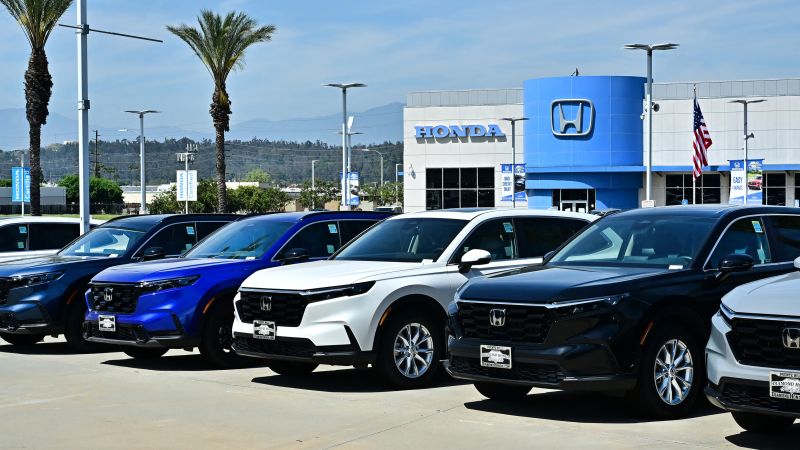
Honda’s First Annual Loss in 70 Years: A Shift in Strategy
Honda just lost money for the first time in 70 years, marking a significant turning point for the Japanese automaker. This financial setback comes as part of a broader industry trend where many manufacturers have recalibrated their electric vehicle (EV) strategies following changes in US emissions regulations. The company’s recent report revealed a net loss of 403.3 billion yen, or approximately $2.6 billion, for its fiscal year ending in March 2026. This is a stark contrast to its previous performance, which had seen consistent profitability for decades.
The Impact of US Policy Changes
The Trump administration’s decision to roll back stringent emissions rules and eliminate the $7,500 tax credit for American EV buyers played a critical role in Honda’s financial decline. These policy shifts, implemented in 2025, led to a sharp drop in EV sales as consumers and investors became hesitant to commit to long-term electrification goals. Automakers like Honda had anticipated a rapid transition to all-electric fleets, but the uncertainty surrounding US regulations forced them to pivot. The removal of financial incentives, combined with the complexity of adapting to new rules, created a perfect storm for companies that had heavily invested in EV infrastructure.
Financial Implications of the EV Pullback
Honda’s loss is emblematic of the broader financial strain faced by automakers who scaled back their EV ambitions. The company’s fiscal year results showed a 1.6 trillion yen writedown, nearly $10 billion, on its previous EV investments. This writeoff significantly impacted its overall earnings, transforming what could have been a $7.4 billion profit into a net loss. Other major players in the industry, such as General Motors, Ford, and Stellantis, also reported substantial charges due to their revised strategies. While GM managed to maintain profitability despite its $7.2 billion charge, Ford and Stellantis faced net losses, highlighting the uneven impact of the industry’s strategic realignment.
The Cost of Delaying Electrification
Automakers have been forced to reassess their long-term plans due to the combination of regulatory uncertainty and market dynamics. The shift from EVs to gas-powered vehicles, particularly trucks and SUVs, has been a pragmatic move to align with current consumer preferences and profit margins. However, this decision has come at a steep financial cost. Honda’s $10 billion writedown is part of a global trend where companies are writing off billions in EV-related assets. The economic toll of this transition is expected to persist as the industry continues to navigate the balance between traditional fuel vehicles and the growing demand for sustainable alternatives.
Despite the setbacks, Honda and its competitors remain committed to electrification. The company has signaled that it will continue investing in EV technology, albeit at a more measured pace. This cautious approach reflects the broader industry’s realization that a complete pivot to electric vehicles may not be feasible without consistent policy support. The current strategy of focusing on hybrid and plug-in hybrid models as intermediaries between internal combustion engines and full electrification is a strategic attempt to mitigate risks while maintaining a foothold in the evolving market.
Global Regulations and Market Competition
While the US policy changes have created challenges, stricter emissions regulations in Europe and Asia continue to push automakers toward electrification. In particular, the European Union’s commitment to phasing out gasoline and diesel vehicles by 2035 has kept the pressure on manufacturers to innovate. Honda’s decision to temper its EV ambitions in the US does not necessarily signal a retreat from its global electric vehicle goals. The company is likely leveraging the US market’s uncertainty to focus on more favorable regions where the transition to EVs is already underway.
Additionally, the rise of Chinese automakers as key players in the EV market has intensified competition. Companies like BYD and NIO have capitalized on the global shift toward electrification, offering competitive pricing and advanced technology. Honda’s recent losses underscore the need to adapt to this evolving landscape. The company must now navigate not only regulatory changes but also the growing influence of Chinese EV brands, which are increasingly challenging established automakers. This multi-faceted challenge has forced Honda to reevaluate its approach to both domestic and international markets.
In conclusion, Honda’s first annual loss in 70 years is a clear indication of the financial risks associated with shifting focus from EVs to traditional vehicles. While the company has managed to avoid deeper losses by adjusting its strategy, the broader industry faces similar hurdles. The interplay between policy changes, market competition, and consumer behavior will continue to shape the automotive sector in the coming years. For Honda, the path forward involves a delicate balance between profitability and long-term sustainability, a challenge that will define its next chapter in the industry.





