
Feds reveal details of alleged plot to attack White House UFC event with explosive drones
FBI Thwarts Alleged Plot to Attack White House UFC Event with Explosive Drones
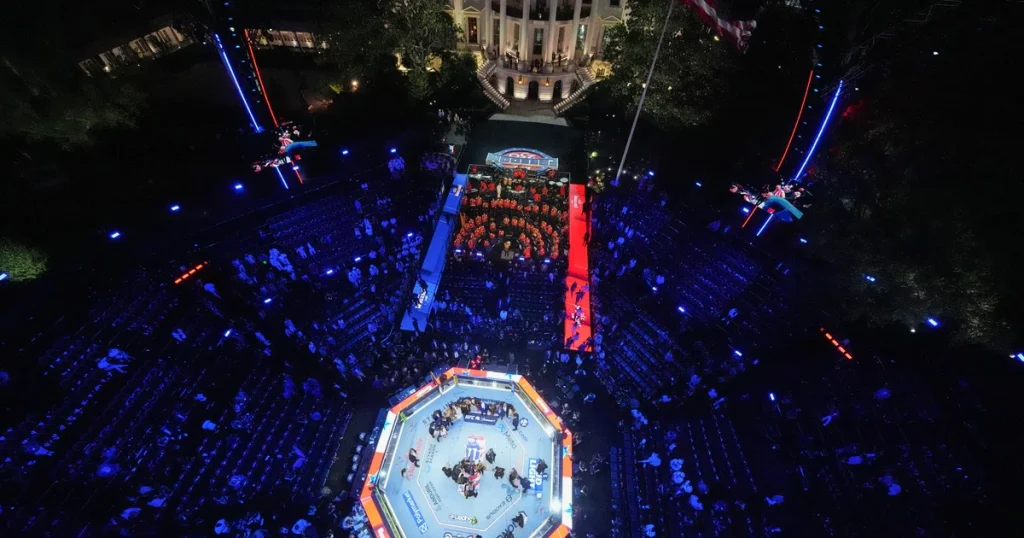
Feds reveal details of alleged plot – On Tuesday, federal authorities revealed they had successfully disrupted a plot targeting the UFC America 250 event held at the White House on Sunday. The event coincided with President Trump’s 80th birthday and marked a celebration of the United States’ 250th anniversary. Thousands gathered on the South Lawn to watch the fights, with the president seated prominently in the front row. The disruption came after the FBI and local law enforcement intercepted plans to use small drones equipped with explosives and snipers to strike senior government officials and affluent attendees.
Five Suspects in Custody
A law enforcement source confirmed that five individuals are currently in custody. Among them is Tycen Proper, a 19-year-old suspect arrested in the Southern District of Ohio on Monday. According to court documents, Proper faces four charges, including attempted murder of a federal officer and conspiracy to commit an offense against the U.S. He is scheduled to appear before a detention hearing on Wednesday. The FBI has not disclosed the identities of the other suspects, though it noted that the plot involved coordinated efforts across multiple jurisdictions.
“Proper admitted to planning a coordinated attack during the UFC event, which he described as a way to ‘jumpstart’ a revolution in the U.S.,” stated an FBI affidavit. The document further detailed how the suspect communicated with others through a TikTok group called “Vanguard of the Old,” where members expressed a desire to protect the nation and believed it was moving in the wrong direction.
The Attack Plan and Its Execution
Proper’s interview with federal agents, conducted on Thursday, outlined a methodical strategy. He claimed the group would stage a “demonstration” on the north side of the White House before launching the attack. During this demonstration, drones would be deployed to detonate explosives over the UFC arena, forcing attendees to evacuate toward the south. Snipers and additional shooters were then planned to target fleeing individuals, including “high value targets” such as wealthy people and politicians.
The FBI emphasized that the plan relied heavily on encrypted communication. Members of the group continued discussions via the Signal app, where they coordinated details of the operation. Proper described how the group would leave their homes on Friday or Saturday to meet in Fredericksburg, Virginia, before traveling to Washington. From there, they would execute the attack, using drones as the primary weapon and snipers as backup.
Clues Found in Proper’s Home
On Thursday, agents executed a search warrant at the home of Proper’s parents, where he resides. The operation uncovered a significant amount of ammunition and tactical clothing, suggesting the group was well-prepared for the assault. Investigators also spoke with Proper’s father and grandmother, who reported that he spent most of his time online engaging with others, often late into the night.
Family members expressed concern about Proper’s recent online activity, including “sympathetic comments about Adolf Hitler” and antisemitic content shared on his social media. These statements, according to the affidavit, raised red flags for law enforcement. The FBI noted that the threat was identified after a relative reached out, worried that Proper had been discussing plans to carry out a “nefarious act” in Washington, D.C.
Targeting Political Figures and AIPAC
The investigation revealed that Proper had targeted specific lawmakers for his attack. His phone messages with alleged co-conspirators, reviewed by the FBI, indicated an intent to strike at politicians who he believed were influenced by AIPAC, a pro-Israel lobbying group. The list included West Virginia Senators Jim Justice and Shelley Moore Capito, as well as Representatives Carol Miller and Riley Moore. Proper’s notes also referenced Senator Marsha Blackburn of Tennessee, whom he identified as a potential target in a May chat.
“I got a possible target Marsha Blackburn is senator for Tennessee,” Proper wrote in a May chat, according to the affidavit. The message reflected his broader focus on politicians he viewed as complicit in “taking money” from AIPAC, which he accused of steering national policy in favor of Israel.
Encrypted Chats and Safe House Planning
Detailed analysis of Proper’s cell phone and Signal chats uncovered group discussions that included role assignments and specific locations. The group planned for members to occupy strategic positions as shooters, with some assigned to the north side of the White House and others to the south. They also discussed a potential “safe house” for escape after the attack, as well as routes to flee the area. The FBI noted that one suspect intended to escape along the Potomac River, highlighting the group’s emphasis on evading capture.
Further investigation into Proper’s digital communications revealed the use of SimpleX, an encrypted messaging app, to plan the attack. The FBI’s review of these messages showed the group’s meticulous preparation, including mapping out escape paths and rehearsing their roles. The suspects’ shared belief in the necessity of the attack as a revolutionary act underscored the ideological motivation behind the plot.
Implications for National Security
The thwarted attack has raised questions about the potential for similar threats in the future. Law enforcement officials highlighted the use of drones and snipers as a combination that could cause significant damage, especially given the high-profile nature of the White House event. The FBI’s ability to uncover the plot through digital surveillance and witness interviews demonstrates the importance of monitoring online activity in counterterrorism efforts.
While the details of the plot remain under scrutiny, the disruption of this plan has prevented a potential tragedy. Proper’s statements and the group’s coordinated actions illustrate how modern technology can be leveraged for both communication and coordination in attacks. The case also serves as a reminder of the growing threat posed by individuals who use social media and encrypted apps to organize and execute their plans, often with little regard for public safety.
As the investigation continues, authorities are likely to examine whether other individuals or groups may have similar intentions. The White House, already a focal point for political events, now faces the challenge of ensuring such threats are mitigated. The FBI’s swift action has prevented the attack, but the underlying motivations and methods suggest that vigilance will remain crucial in the days ahead.