
Live Updates: Iran says it will expand control in Strait of Hormuz as oil and gas prices continue to climb
Live Updates: Iran Says It Will Expand Hormuz Control
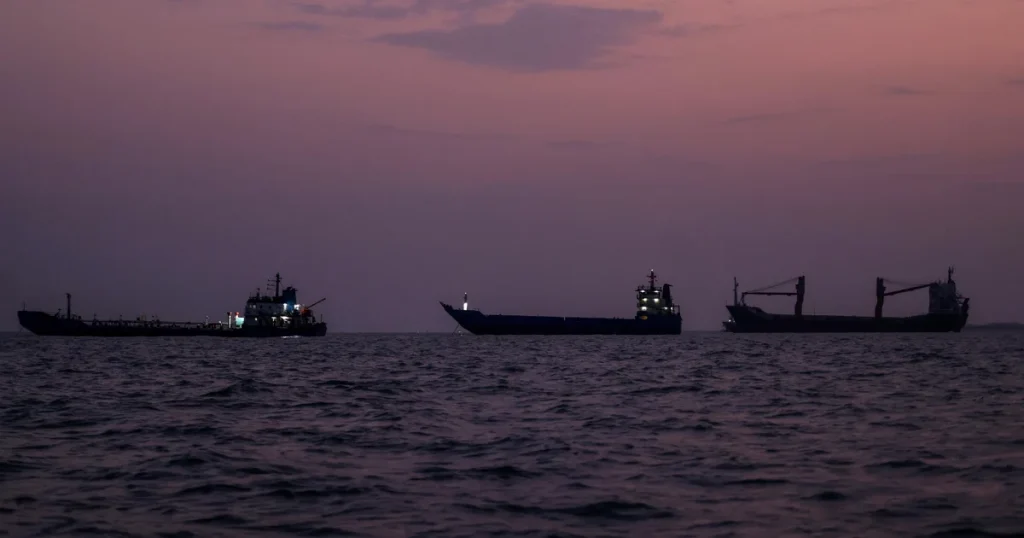
Bizeconanalysis.com – Live Updates: Iran says it will widen its grip over the Strait of Hormuz while global oil and gas prices keep climbing. Mohsen Rezaei, the newly installed chair of Iran’s Supreme National Security Council, announced a maritime “exclusion zone” that would run from the American naval blockade line, through the strait itself, and deep into the Persian Gulf. The declaration came a single day after Washington destroyed three Iranian oil tankers in reprisal for ballistic-missile salvos aimed at U.S. warships, and it left shipping desks and allied navies scrambling for details that have yet to materialize.
What the Exclusion Zone Actually Covers
Rezaei told state television that precise boundaries would be drawn over “the coming days and weeks,” stretching from the blockade line toward the strait and onward into the Gulf. No coordinates were published. No enforcement timetable was offered. No penalty schedule for non-compliant vessels was outlined. For a corridor through which roughly one-fifth of the world’s daily liquid-oil consumption has historically flowed, that absence of specificity has already pushed crude flows to near-zero and left insurers repricing risk in real time.
The zone’s stated purpose is to intercept any vessel Tehran judges to be attempting unauthorized transit. In practice, it formalizes a chokehold that has existed informally since the February campaign in which the United States and Israel struck Iranian targets. Tehran has refused to reopen the waterway to ordinary commercial traffic, and this announcement signals an intent to tighten the grip further rather than loosen it.
Diplomatic Pressure on Seoul
While the military front escalates, Tehran is also working the diplomatic flank. Iran’s foreign ministry issued a pointed warning to South Korea on Monday, instructing Seoul not to station military assets or otherwise entangle itself with American operations around the strait. Spokesperson Esmaeil Baghaei framed the message as a rebuke of what he called “U.S. pressure and intimidation” on allied capitals.
“Any military deployment or participation in operations by other countries in the Persian Gulf or the Strait of Hormuz can only be regarded as direct support for the party responsible for that aggression and will have serious consequences,” Baghaei wrote on X.
The timing is deliberate. On Friday, Seoul’s government had signaled it would weigh joining joint naval operations, contingent on preserving its own force readiness, while stressing no final decision had been reached. Iran’s intervention appears calibrated to chill that deliberation before it hardens into a binding commitment.
Oil and Gas Prices Keep Climbing
The economic shock is already visible at the pump and on trading floors. Brent crude, the benchmark for internationally traded oil, added another 67 cents to close at $96.95 per barrel. U.S. drivers felt the squeeze heading into the holiday weekend: the national average for regular gasoline hit $4.14 per gallon, roughly a dollar above the same period last year and well past the Labor Day 2012 peak of $3.82, per AAA motor-club data. Live Updates: Iran says it will continue tightening the strait’s operational parameters, which means the price trajectory is unlikely to reverse in the near term.
Washington Signals Escalation Will Be Met in Kind
U.S. Central Command confirmed Saturday that it had “permanently disabled” three Iranian oil tankers operating in the Persian Gulf and the Gulf of Oman. Commander Adm. Brad Cooper used the briefing to deliver an explicit deterrent message to Iran’s Islamic Revolutionary Guard Corps.
“Let the message to the IRGC be clear: If you shoot at two of our ships, we will impose an even higher economic cost — taking out three of yours,” Cooper said. “We will not hesitate to defend American forces, and if necessary, destroy Iran’s limited and exposed oil fleet.”
By quantifying the exchange ratio — two American ships struck, three Iranian tankers destroyed — Cooper is communicating that the next round of Iranian aggression will trigger a proportionally larger American response. It marks a deliberate break from the measured tit-for-tat logic that had governed earlier exchanges.
Iran’s parliament speaker, Mohammad Bagher Ghalibaf, echoed the escalation logic from the Iranian side on Sunday. In remarks carried by state media, Ghalibaf declared that Tehran would answer future American strikes with greater speed and force, following the episode in which Iranian forces targeted U.S. warships in retaliation for the tanker attacks. Live Updates: Iran says it will match and exceed any next American action, closing the loop on a tit-for-tat cycle that both sides now appear determined to outpace.
Frequently Asked Questions
What exactly is Iran’s new “exclusion zone” in the Strait of Hormuz?
It is a maritime area stretching from the U.S. naval blockade line through the strait and into the Persian Gulf, intended to intercept vessels Tehran deems to be transiting without authorization. Specific coordinates, enforcement dates, and penalty schedules have not yet been published.
How much of the world’s oil passes through the Strait of Hormuz?
Roughly one-fifth of global daily liquid-oil consumption has historically transited the waterway. Since the February campaign, that flow has plunged sharply, and Tehran has refused to reopen the corridor to normal commercial traffic.
What happened to the three Iranian tankers?
U.S. Central Command confirmed on Saturday that Adm. Brad Cooper’s forces “permanently disabled” three Iranian oil tankers in the Persian Gulf and Gulf of Oman. The strikes were framed as retaliation for ballistic-missile launches aimed at U.S. warships.
Why is South Korea being targeted diplomatically?
Seoul indicated on Friday it would weigh participation in joint naval operations in the region. Iran’s foreign ministry warned Seoul not to deploy military assets or join American operations, framing any such step as “direct support” for what Tehran calls the aggressor.