
Powerful earthquake off Cuba felt across South Florida, prompts evacuations and transit disruptions
Powerful Earthquake Off Cuba Causes Tremors in South Florida, Sparks Evacuations and Service Interruptions
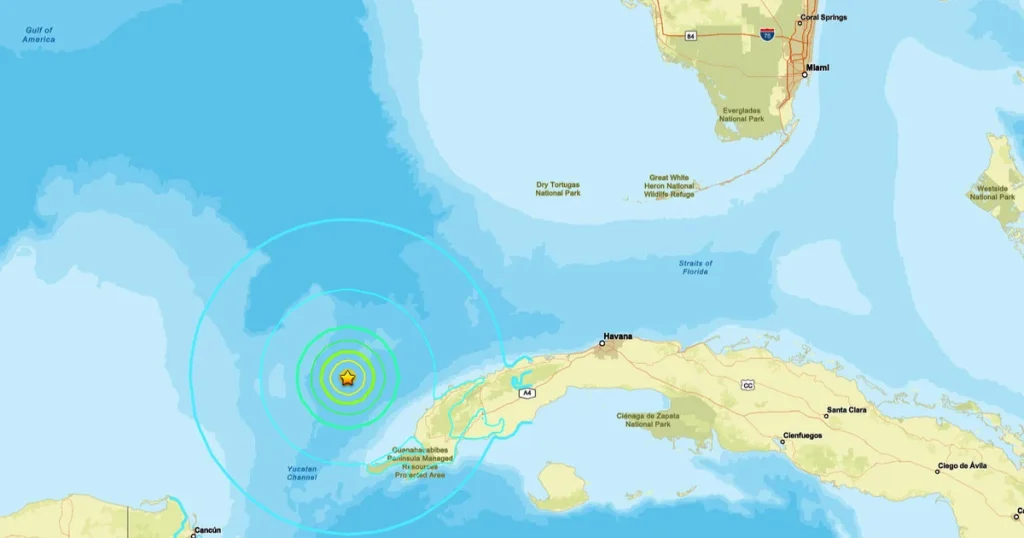
Powerful earthquake off Cuba felt across – On Monday afternoon, a 6.1-magnitude earthquake struck near the northwest coast of Cuba, sending ripples of light shaking across parts of Florida. The tremors were particularly noticeable in South Florida, where residents experienced the unusual phenomenon of seismic activity. This event marked the first significant tremor in the region in some time, drawing attention from local authorities and sparking reports of evacuations and disrupted transportation services.
Seismic Activity in South Florida
The United States Geological Survey (USGS) confirmed the earthquake’s epicenter was approximately 65 miles west-northwest of Mantua, Cuba, a location situated west of Havana. The seismic event was about 376 miles from Miami, placing it in the open waters of the Caribbean Sea. Despite its distance, the tremors were felt in several urban areas, including Tampa, Orlando, and Miami, where the ground shook faintly but noticeably.
“Shaking from the recent M6.1 earthquake offshore of Cuba was felt in Florida, where earthquakes are not commonly experienced. Did you feel it? (If you’re in the area and did not feel it, that’s data too!),” USGS shared on X.
Residents in Miami and surrounding regions described the sensation as a brief but unsettling tremor. The city’s officials acknowledged the quake, stating that they were aware of the seismic activity and that multiple calls for service were reported due to the tremors. Miami Fire-Rescue responded to each incident, ensuring that residents were safe and that any potential concerns were addressed promptly.
The earthquake also caused temporary disruptions in public transportation within Downtown Miami. According to Miami-Dade County, both Metrorail and Metromover services were suspended following the evacuation of the Stephen P. Clark Center. The decision to evacuate was based on reports of building shaking, which prompted immediate action to ensure the safety of occupants. Fortunately, both transit services resumed operations after the situation was assessed and deemed stable.
Community Reactions and Evacuation Details
In South Dadeland, a nearby community, the tremors led to at least one building evacuation. A CBS News Miami reporter spoke with a resident who described the event as a sudden, brief shake that left people questioning its cause. “We just felt like a shaking and we’re like, ‘Oh, what was that?'” the individual recounted. “We just heard an alarm and it said for everyone to evacuate the building.”
“We just feel like a shaking and we’re like, ‘Oh, what was that?’ And we just heard an alarm and it said for everyone to evacuate the building,” Maria Torrado told CBS News Miami.
Torrado noted the presence of a large police and fire-rescue force at the scene during the evacuation. She explained that occupants remained outside for roughly 45 minutes before being allowed to return to their homes. The experience left many residents unsettled, highlighting the unexpected nature of such seismic events in the region.
Following the quake, the National Weather Service in Miami issued an update confirming there was no tsunami threat in South Florida. This reassurance was crucial for residents, as tsunamis are a common concern in coastal areas after major earthquakes. The service emphasized that the tremors, while notable, were not strong enough to generate a tsunami.
Cuba’s Experience with Seismic Activity
While the earthquake’s primary impact was felt in Florida, it also caused concern in western Cuba. The Associated Press reported that buildings across the region experienced shaking, prompting residents to take precautionary measures. Although no injuries or significant damage were immediately reported, the event raised questions about the stability of the island’s infrastructure.
“The shaking rattled the building and frightened people in the area,” Flavia Pupo, a hotel manager in Pinar del Río, told AP by telephone.
Pupo described the experience as a sudden, jarring sensation that left people in the streets feeling anxious. “Everyone here is OK,” she added, “but the people on the street are a little bit scared.” Her comments underscored the community’s reaction to the unexpected seismic activity, which is less frequent in Cuba compared to more seismically active regions like the Caribbean.
Cuba has a history of seismic events, particularly in the Oriente fault zone, which has been responsible for damaging earthquakes in recent centuries. The Associated Press highlighted that this fault zone produced a magnitude 7.7 quake in January 2020, which caused damage in Cuba and the Cayman Islands. This recent event, though smaller, serves as a reminder of the island’s vulnerability to tectonic activity.
Historical Context: Florida’s Earthquake Exposure
Although Florida is not typically associated with frequent earthquakes, the region has experienced seismic events in the past. The 2020 magnitude 7.7 quake, which originated south of Cuba and northwest of Jamaica, was felt in Miami and other parts of South Florida. At the time, residents described the shaking as similar to the sensation of feeling light-headed, with some reporting that their buildings seemed to move.
“I was sitting at my desk in Aventura, and I felt motion similar to feeling light-headed,” a resident shared with CBS News Miami during the 2020 event.
Residents in Miami recounted their experiences, noting that the tremors were unexpected but brief. The event served as a wake-up call for the region, demonstrating that even moderate earthquakes can have noticeable effects on the Florida coastline. The current 6.1-magnitude quake, while less severe, followed a similar pattern, reinforcing the idea that Florida is not immune to seismic activity.
Experts suggest that the region’s proximity to the Caribbean Sea and its location near active fault lines contribute to the occasional tremors. While the frequency of earthquakes in Florida is low, their potential impact is significant, especially for densely populated areas. The recent event in South Florida highlights the importance of preparedness, even in regions with relatively stable geological conditions.
The USGS and other agencies continue to monitor the situation, gathering data from residents and analyzing the earthquake’s effects. This information will help improve understanding of the region’s seismic risks and inform future disaster response strategies. For now, the focus remains on ensuring that the community remains safe and that any lingering concerns are addressed through accurate communication and timely action.
As the days pass, the story of the 6.1-magnitude earthquake serves as a reminder of the interconnectedness of geological events and their far-reaching consequences. While the immediate impact in South Florida was minimal, the event underscores the need for vigilance and the importance of preparedness in the face of unexpected natural phenomena. Residents and officials alike remain on alert, ready to respond to any further developments in the region.
With the data collected from this event, experts hope to better predict future seismic activity and its effects on both Cuba and Florida. The 2020 magnitude 7.7 quake and the current 6.1-magnitude event are part of a broader pattern that highlights the dynamic nature of the Earth’s crust. As the island nation and the Florida coast continue to experience these tremors, the importance of resilient infrastructure and community awareness becomes increasingly evident.
In conclusion, the earthquake off Cuba, while not catastrophic, has left a noticeable mark on South Florida. The combination of light shaking, evacuations, and service interruptions serves as a case study for how even moderate seismic events can disrupt daily life. As the region adapts to these occurrences, the hope is that lessons learned will help mitigate future impacts and enhance preparedness for any seismic activity that may arise.