
Huge, invasive Joro spiders are spreading in several states again. Here’s what to do if you spot one.
Huge Invasive Joro Spiders Are Spreading
Bizeconanalysis.com – Every spring, homeowners and trail-goers across the American Southeast start spotting something they did not plant: vast, geometrically precise webs draped between oak branches, fence posts, and patio structures. The architect of those webs is the Joro spider, an East Asian arachnid whose first confirmed U.S. sighting landed in Georgia in 2014. Huge invasive Joro spiders are spreading well beyond that original introduction point, with confirmed activity this year in Georgia, North Carolina, South Carolina, Tennessee, and Alabama — part of a range that now stretches across more than a dozen states, overwhelmingly in the Southeast.
The species poses no meaningful threat to people, yet its ecological footprint remains unclear. That uncertainty is precisely why researchers are asking the public to observe, photograph, and report rather than squash.
What You Are Actually Looking At
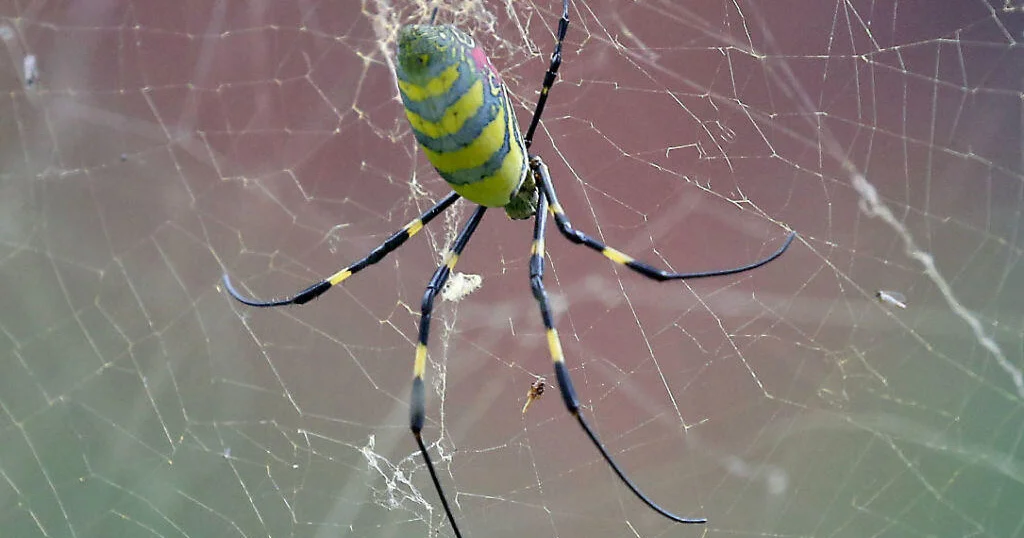
A full-grown female measures roughly one inch from head to abdomen tip, with a leg span approaching four inches. Her abdomen glows a vivid yellow streaked with bluish-green longitudinal bands, and her legs carry bold alternating black-and-yellow rings. Males are considerably smaller and shift toward a drab, muted brown, which is why most public sightings involve females.
You may have seen the nickname “flying spider” attached to this species in social-media posts. The label is misleading. No adult Joro drifts through the air. What does occur is a juvenile dispersal behavior called ballooning: very young spiders release gossamer-thin silk filaments that catch thermal updrafts and carry them considerable distances. Many orb-weaver species share this trait, but for the Joro it has proven effective enough to seed new populations far from the original introduction site.
How the Range Is Being Mapped
This week the Great Smoky Mountains National Park, which straddles the Tennessee–North Carolina border, posted a visitor notice reminding the public that Joro spiders “may be hanging in a web near you.” The park’s social-media message went further, asking visitors to help document where the arachnid is appearing.
“The invasive joro spider has been slowly spreading through the Smokies, and we need your help to track its whereabouts.”
Those photographs feed directly into year-by-year range-mapping work led by researchers at the University of Tennessee. Park visitors are asked to snap a photo of any spider they encounter and submit it through the iNaturalist app or by emailing UTKJoroProject@utk.edu. Sightings outside park boundaries can be logged on iNaturalist or shared with other citizen-science networks.
Why Researchers Are Asking You to Leave Them Alone
The impulse to reach for a shoe or a rolled-up newspaper when a four-inch-legged spider drops into your path is understandable. Researchers, however, actively discourage that reflex for two distinct reasons.
Caitlin Jones, a graduate student at the University of Tennessee currently conducting spider surveys inside the national park, pointed first to the regulatory constraint: disturbing wildlife within a national park is against the law. Beyond the rulebook, though, there is a deeper scientific rationale.
“We just want to kind of discourage people from killing them anytime they see them. Not only do we not know what they’re doing, but they are also very easily misidentified — our natives are very easily misidentified as invasive.”
Jones’s specific line of inquiry examines how the Joro’s presence affects populations of native orb-weavers that have long occupied the same ecological niche in southeastern forests and suburban yards. If the Joro is outcompeting those natives, that information is critical for conservation planning. Removing individuals before the data is collected undermines the study. Compounding the problem, the Joro closely resembles several native orb-weavers, so a casual swat often eliminates a spider that was never invasive at all.
Are Bites or Web Contact Dangerous?
A peer-reviewed study published last year in the Journal of Medical Entomology examined spider–human interactions and described itself as the first controlled study of spider bites. The findings were reassuring: bites from the species were mild, localized, and resolved without intervention. Web contact, while startling, causes no lasting skin reaction in the small sample examined.
The practical takeaway for anyone who spots a large orb-weaver in the Southeast this season: photograph it, note the location, upload the image, and walk around the web. The species is not a health hazard, and every intact specimen left in place adds a data point to the ongoing effort to understand how this invasive arachnid is reshaping southeastern ecosystems.
Frequently Asked Questions
Will a Joro spider bite make me sick? Current evidence from controlled bite studies indicates bites are mild and self-limiting. Treat any bite as you would a minor insect sting: clean the area, apply a cold compress if needed, and seek medical attention only if signs of infection develop.
How do I confirm the spider in my yard is actually a Joro and not a native orb-weaver? Look for the vivid yellow abdomen with bluish-green stripes and the bold black-and-yellow leg banding on a female roughly one inch long. If the markings are muted or the size is smaller, it is likely a native species. When in doubt, photograph it and submit the image through iNaturalist for expert verification.
Can I remove the web from my patio without harming the spider? Yes. Gently cut or roll the silk away from the structure and set the spider aside in a container with ventilation, then release it at least a few hundred feet from your property. This preserves the specimen for observation while clearing the area.
Where should I report a sighting outside the Smoky Mountains? Use the iNaturalist app to upload a photo with location data. You can also email images to UTKJoroProject@utk.edu for inclusion in the University of Tennessee’s range-mapping dataset.