
USS Abraham Lincoln leaves Middle East after 9-month deployment
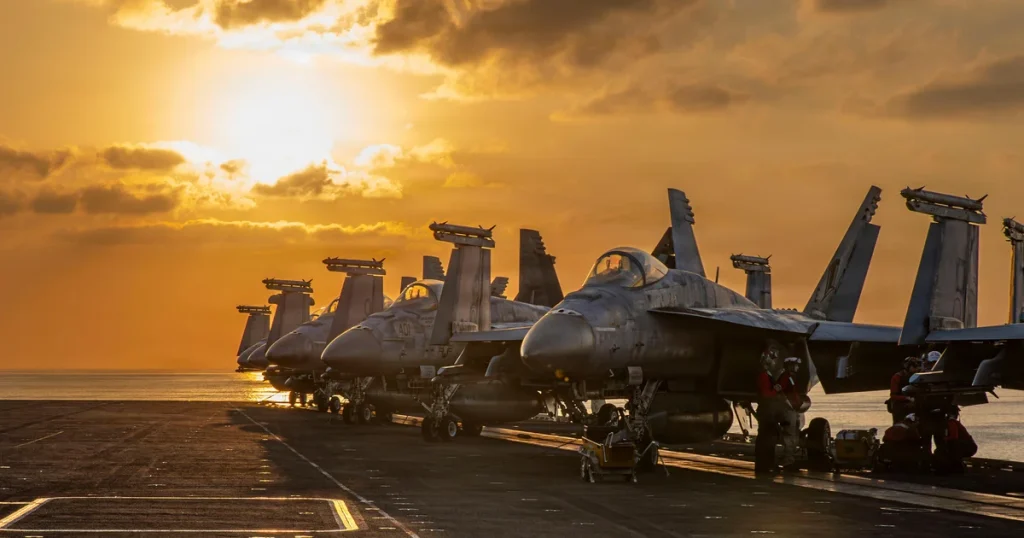
USS Abraham Lincoln Heads Home After Extended Middle East Tour
Bizeconanalysis.com – The aircraft carrier USS Abraham Lincoln has departed the Middle East theater, bringing to a close a nine-month deployment that stretched far beyond its original timeline. Roughly 5,000 sailors and Marines aboard the ship are now en route back to their home port of San Diego, California. A U.S. official confirmed the departure on Thursday, marking the end of one of the longest continuous carrier deployments in recent memory.
The Lincoln’s mission was dramatically lengthened by the war with Iran, which erupted in February and pulled the carrier into sustained combat operations. What had been planned as a routine rotational deployment became a months-long combat assignment, with the ship serving as a launch platform for thousands of aircraft sorties in support of strikes against Iranian targets. The extended workload and operational tempo placed extraordinary strain on the crew, a fact that family members and congressional observers have not been slow to notice.
Relief Arrives
The Japan-based USS George Washington, another Nimitz-class carrier, has already entered the Middle East to assume the Lincoln’s operational role. The swap ensures continuous carrier presence in the region while allowing the Lincoln’s crew to begin the long transit home. The carrier is expected to require approximately three weeks to complete the voyage back to San Diego, a journey that will offer the first sustained period of rest for personnel who have spent months at sea under combat conditions.
Family Concerns Reach Capitol Hill
Well before the ship cleared the region, relatives of crew members had begun sounding alarms about conditions aboard. Writing in Military Times and Stars and Stripes, family members described deteriorating mental health among sailors, unsanitary living quarters, and shortages of adequate food. Those accounts did not remain confined to service-press pages; they quickly drew the attention of members of Congress, who pressed the Pentagon for answers.
At the highest levels of government, officials moved to downplay the reports. President Trump suggested the ship simply had not been deployed long enough to warrant such complaints. Defense Secretary Pete Hegseth echoed the dismissive tone. Acting Secretary of the Navy Hung Cao went further, characterizing the media coverage of onboard conditions as “dishonest.”
Admiral Cooper Visits the Ship
U.S. Central Command Admiral Brad Cooper took a different approach. Over the weekend preceding the carrier’s departure, Cooper boarded the Lincoln to speak directly with crew members and assess conditions firsthand. In public remarks following the visit, he acknowledged the difficulty of sustained at-sea operations without confirming any specific systemic failures.
“Deployment at sea is uniquely challenging and tough, and every single one of us, including me, reacts to stressors in different ways.”
Cooper framed the discussion in broader terms of well-being, emphasizing that psychological welfare deserves the same institutional attention as physical and spiritual health.
“I’ve long believed that mental health is another aspect of individual health and requires our attention just like physical health and spiritual health.”
The Navy, for its part, stated that it has not observed an uptick in reported suicide attempts or suicidal ideation among the Lincoln’s complement. Separately, the service confirmed it is investigating an August 3 incident in which a sailor fell overboard and was subsequently recovered.
A Father’s Plea
For families waiting on the California coast, the abstract statistics of deployment length and sortie counts pale beside the simple desire to see a loved one home. Jefferson Kelley, whose son Jackson is aboard the Lincoln on his first deployment, told CBS News last week that the waiting has become almost unbearable.
“What’s going through my mind as a parent is that need to want to be there, to want to be there for your child.”
He went on to describe the lengths he would go to shorten his son’s absence:
“I would get on a plane or helicopter tonight to get shipped out to the Lincoln if it meant bringing him home to his mom and his siblings and his family.”
What Comes Next
The Lincoln’s return to San Diego, expected within roughly three weeks, will trigger a period of shore leave, medical screening, and administrative processing before crew members rejoin their families. For many of the 5,000 personnel involved, this will be the first time in months they have stepped off a warship. The extended deployment, compounded by active combat operations against Iran, represents a significant test of the Navy’s ability to sustain carrier crews under prolonged operational stress. How the service addresses the concerns raised by families and lawmakers in the weeks ahead will shape both public confidence in the fleet and internal morale among sailors who may be called back to sea in the near future.
The carrier’s departure from the Middle East does not end the broader strategic picture. With the George Washington now in theater, the United States maintains its carrier presence in the region, and the question of how long the Lincoln’s crew can rest before another rotation remains open. For now, however, the most immediate story is one of exhaustion, relief, and the long transit home.
Related Reading
Frequently Asked Questions
What is USS Abraham Lincoln leaves Middle East?
USS Abraham Lincoln leaves Middle East is the main topic of this guide. The article explains the context, practical details, and next steps readers should understand.
Why does USS Abraham Lincoln leaves Middle East matter?
USS Abraham Lincoln leaves Middle East matters because readers are looking for a useful answer, not just a short summary. Good content should match search intent and help them decide what to do next.