
In France, Hegseth invokes immigration and “invasion” in D-Day remarks
In France, Hegseth Invokes Immigration and “Invasion” in D-Day Remarks
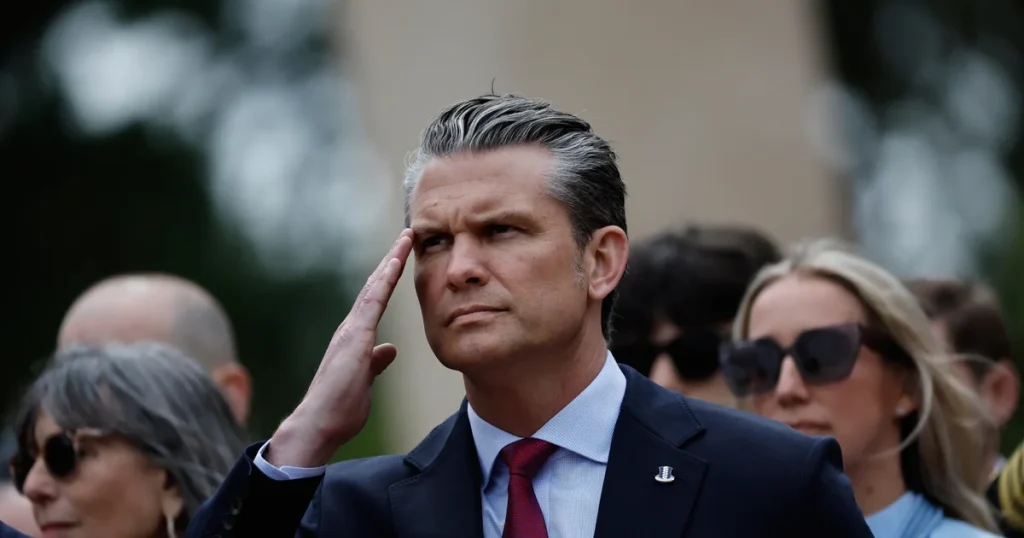
In France Hegseth invokes immigration and invasion – On Saturday, U.S. Defense Secretary Pete Hegseth delivered a speech at the Normandy American Cemetery in Colleville-sur-Mer, northwest France, during the 82nd anniversary of the June 6, 1944, Allied landings. The event, which honored the sacrifices of American soldiers during World War II, became an unexpected platform for Hegseth to draw a connection between historical warfare and contemporary concerns over immigration. His remarks stirred debate, as they seemed to equate modern maritime migration with the wartime invasion that reshaped Europe.
Hegseth’s address, delivered amid solemn ceremonies at the cemetery, included a striking metaphor that juxtaposed past and present. He warned that the freedom secured by Allied forces during D-Day could be at risk if European leaders failed to act decisively. “Different European beaches are stormed by different dangerous ideologies,” he said, highlighting a sense of urgency. The speech underscored a growing tension between the U.S. and Europe, particularly as immigration issues have become a focal point of political discourse.
“Beaches in Spain and Italy and Greece and Bulgaria. Boats and men arrive,” Hegseth added, using vivid imagery to describe the current wave of migration. His words evoked the chaos of wartime Europe, yet they also hinted at a broader critique of how modern Europe is grappling with the influx of migrants. The analogy, though not explicitly stated as such, aligned with the Trump administration’s long-standing emphasis on border security and the perceived threat of “invasion” to national identity.
During the ceremony, Hegseth participated in a wreath-laying tradition, honoring the fallen soldiers whose graves are etched in the memorial. While he did not use the term “immigration” directly, his remarks resonated with the administration’s rhetoric on migration, borders, and the censorship of nationalist voices. Critics argue that his speech subtly framed the issue as a crisis of sovereignty, echoing concerns that European nations are losing control over their populations to external forces.
The remarks were part of a larger conversation about the role of the United States in European affairs. Hegseth’s focus on the “invasion” of Europe through immigration reflects a recurring theme in his tenure as defense secretary. His comments come as the U.S. continues to scrutinize European responses to migration, particularly in the wake of the 2023 national security strategy that warned of a “prospect of civilizational erasure.” This strategy, introduced under the Trump administration, projected a future where Europe could become “unrecognizable” within two decades due to shifting demographics and cultural influences.
“When will European capitals do something about that invasion? Or is it too late?” Hegseth asked, his tone blending reverence for history with a sharp critique of current leadership. “I pray not, and I believe not.” The phrase, though brief, carried weight, suggesting a lack of faith in European unity or preparedness to address what he described as a growing existential threat.
Hegseth’s speech also sparked discussions about the ideological undercurrents of his arguments. By comparing modern migration to the invasion of Europe during World War II, he positioned the issue as a battle for cultural preservation. This approach mirrors the administration’s broader narrative, which often frames migration as a challenge to traditional values and national security. The rhetoric aligns with concerns that European nations are prioritizing open borders over the protection of their own populations, a sentiment amplified by the increasing numbers of migrants arriving via sea.
In a related development, British Prime Minister Keir Starmer’s office swiftly condemned U.S. Vice President JD Vance for attributing the killing of Henry Nowak, an 18-year-old British student, to immigration. Nowak was stabbed to death in Southampton, and both the victim and perpetrator were British citizens, yet Vance’s comments drew sharp criticism. Starmer’s office emphasized that the issue was not a failure of immigration policies but a tragic event involving individuals from within the same country. This reaction highlighted the complexity of the debate, where immigration is both a source of unity and a catalyst for division.
While the D-Day commemorations served as a backdrop for Hegseth’s remarks, the speech itself was a calculated move to frame immigration as a critical issue requiring immediate attention. The timing of the address, just weeks after the Trump administration’s warnings about Europe’s future, suggests a strategic effort to underscore the importance of U.S. leadership in addressing global challenges. Hegseth’s focus on the “invasion” of Europe through migration also ties into the administration’s narrative that the influx of people from non-European backgrounds could dilute the continent’s cultural and political identity.
European leaders, however, have remained divided on the issue. Some argue that the current wave of migration is not an “invasion” but a reflection of Europe’s role as a global hub for refugees and asylum seekers. Others, like Hegseth, see it as a threat to the stability and heritage of the region. The contrast between these perspectives underscores the growing rift between the U.S. and Europe on matters of immigration and national security.
Hegseth’s speech at the Normandy American Cemetery was not only a tribute to history but also a statement of the present. By invoking the memory of D-Day, he sought to draw a parallel between the Allied victory and the need for a strong, unified response to today’s challenges. The ceremony, which drew dignitaries and veterans, provided a powerful setting for his message, blending the solemnity of the past with the urgency of the present. As the 82nd anniversary of the June 6, 1944, landings came to a close, the speech left a lasting impression, reminding audiences of the sacrifices made to preserve freedom and the responsibilities that come with it.
The Trump administration’s warnings about Europe’s future have long been a part of the U.S. strategy, with Hegseth’s remarks serving as a continuation of that narrative. By linking the 1944 invasion to today’s migration crisis, he reinforced the idea that Europe’s survival as a distinct civilization depends on its ability to defend its borders and values. This perspective has resonated with some U.S. allies, even as it has drawn criticism from others who view it as an oversimplification of complex global issues.
As the speech drew to an end, Hegseth’s words lingered, inviting further reflection on the parallels between historical and contemporary challenges. The D-Day commemorations, a time to honor the past, became a moment for envisioning the future—one where the lessons of 1944 might guide Europe’s response to the evolving dynamics of migration and identity. The speech, while brief, encapsulated a broader ideological stance, one that continues to shape the discourse between the U.S. and its European partners.