
Hegseth tones down warnings about China: “We respect their ambitions,” but “position hasn’t changed on Taiwan”
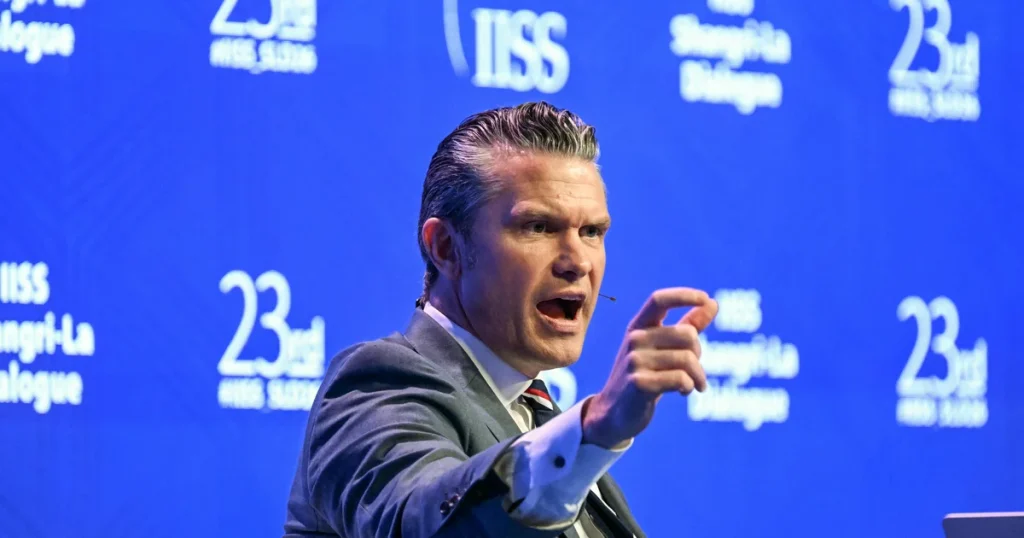
Hegseth Adjusts Rhetoric on China During Singapore Engagement
Hegseth tones down warnings about China – Defense Secretary Pete Hegseth softened his earlier assertions about China’s role in the region during a recent trip to Singapore, yet emphasized the United States’ unwavering commitment to safeguarding its strategic interests. The revised tone, adopted during his address at the Shangri-La defense conference, reflects a deliberate effort to balance diplomatic considerations with geopolitical resolve. While acknowledging China’s growing influence, Hegseth positioned the U.S. as a collaborative partner in maintaining stability, without abandoning its stance on Taiwan.
Revised Messaging Amid Strategic Priorities
Speaking to an assembly of global leaders, diplomats, and security experts, Hegseth underscored Washington’s focus on fostering a “lasting and favorable balance of power in the Pacific.” This priority, he noted, remains central to U.S. foreign policy, even as the administration seeks to avoid provoking Chinese ire. “Our message today aligns closely with the president’s vision,” Hegseth remarked. “We aim to project strength, yet communicate with clarity and openness, ensuring that cooperation remains a cornerstone of our relationship.”
“We respect their ambitions, and we recognize the significant military buildup they have undertaken as a sovereign nation. However, our position regarding Taiwan remains steadfast.”
Despite the shift in phrasing, Hegseth’s core message was clear: China’s rise presents challenges that require careful navigation. He highlighted the nation’s military expansion as a factor necessitating U.S. preparedness, yet framed it as a shared concern rather than a direct confrontation. This approach contrasts with his remarks from the previous year, when he had described China as a “threat” to Taiwan, a statement that drew sharp criticism from Beijing.
Backstory: From Confrontation to Collaboration
Hegseth’s adjustments come in the wake of President Donald Trump’s recent summit with Chinese President Xi Jinping in Beijing. During that visit, Trump praised Xi as a “great leader” and expressed optimism about a “fantastic future together.” This sentiment appears to have influenced Hegseth’s remarks, as he sought to mirror the administration’s broader strategy of engagement. However, the U.S. remains vigilant about China’s potential dominance in the Indo-Pacific, a region critical to global trade and security.
At the Shangri-La conference, Hegseth reiterated that the U.S. and China must “build a constructive relationship of strategic stability” rooted in fairness and mutual benefit. This framework, he explained, allows for both cooperation and competition, ensuring that disagreements do not escalate into conflict. “While our nations will vigorously defend our respective interests, we can also secure agreements that serve both sides,” he stated.
“There is rightful alarm regarding China’s historic military buildup and the expansion of its activities in the region and beyond. A Pacific dominated by any single power would disrupt the balance of power we all seek to uphold.”
These remarks were met with approval from a Chinese military official, Major General Meng Xiangqing, who praised the alignment between Trump and Xi’s policies. Meng noted that the consensus reached during their meeting “should provide strategic guidance for China-U.S. relations over the next three years and beyond.” He framed the agreement as a positive step toward stability, emphasizing that cooperation and competition could coexist within a predictable framework.
Concerns Over U.S. Commitment to Taiwan
Despite Hegseth’s efforts to reassure Chinese leaders, some critics argue the administration is compromising its support for Taiwan. U.S. Senator Tammy Duckworth, part of a congressional delegation attending the conference, voiced apprehension about the Trump administration’s perceived softening on the issue. “I worry that this administration is becoming distracted by conflicts in other regions, at the expense of our Indo-Pacific commitments,” she said. “It seems like our president is adopting policies that align with Beijing’s preferences.”
Duckworth’s concerns echo broader debates within the U.S. political landscape. While Hegseth’s statements suggest a willingness to work with China, they also raise questions about the consistency of American resolve. The senator pointed to the administration’s hesitation in approving a $14 billion arms package for Taiwan as evidence of this shift. “This package is a valuable tool in negotiations,” she noted, “but it also signals a willingness to prioritize China’s interests over Taiwan’s sovereignty.”
Strategic Stability and Regional Implications
Hegseth’s remarks during the conference were part of a larger dialogue on the U.S.-China relationship, with the aim of reinforcing a “strategic stability” that includes both partnership and rivalry. He emphasized the importance of managing differences while maintaining a united front against potential hegemony. “A Pacific dominated by any hegemon would unravel the equilibrium we all seek to preserve,” he warned, underscoring the stakes of regional security.
Yet, the revised rhetoric does not erase the tension that has long characterized U.S.-China interactions. Hegseth’s acknowledgment of China’s ambitions is seen by some as a concession, while others view it as a pragmatic adjustment to avoid unnecessary conflict. The speech also highlighted the U.S. commitment to its allies, as it seeks to uphold a shared vision of a secure and prosperous Indo-Pacific. “Our allies understand the importance of this balance,” he said, “and they recognize that our actions are guided by both strength and diplomacy.”
“We are not going to sugarcoat it — the threat China poses is real, and it could be imminent.”
While Hegseth’s current language is more measured, it carries the same weight as his previous statements. The difference lies in the framing: instead of labeling China as a threat, he now speaks of it as a force whose ambitions must be respected. This nuance, however, does not diminish the urgency of the issue. As the U.S. continues to engage with China, the question remains whether this balance will hold in the face of rising tensions.
Future Outlook and Uncertainty
The Shangri-La conference provided a platform for Hegseth to present his vision of U.S.-China relations, blending cooperation with vigilance. His remarks, though diplomatic, hint at a nuanced strategy that acknowledges China’s influence while safeguarding American interests. The timing of the visit, just two weeks after Trump’s Beijing trip, suggests a coordinated effort to project unity and stability in the region.
However, the path forward is not without challenges. China’s claim over Taiwan, which it sees as an inalienable part of its territory, remains a flashpoint. While Hegseth did not explicitly endorse this claim, his emphasis on mutual understanding and practical agreements leaves room for interpretation. As the U.S. weighs its commitments to both China and Taiwan, the message is clear: the administration is seeking to navigate a complex geopolitical landscape with careful diplomacy, even as it maintains its strategic priorities.
China claims the democratic self-governing island as its own, and Xi has not ruled it out as a potential territory to annex. Hegseth’s visit to Singapore, therefore, represents a strategic moment in the evolving narrative of U.S.-China relations, one that balances respect for Beijing’s ambitions with the protection of Taiwan’s autonomy. The outcome of this balancing act will shape the region’s future for years to come.