
Labor activist Dolores Huerta says Trump “does not know history” with past comments on Mexican people
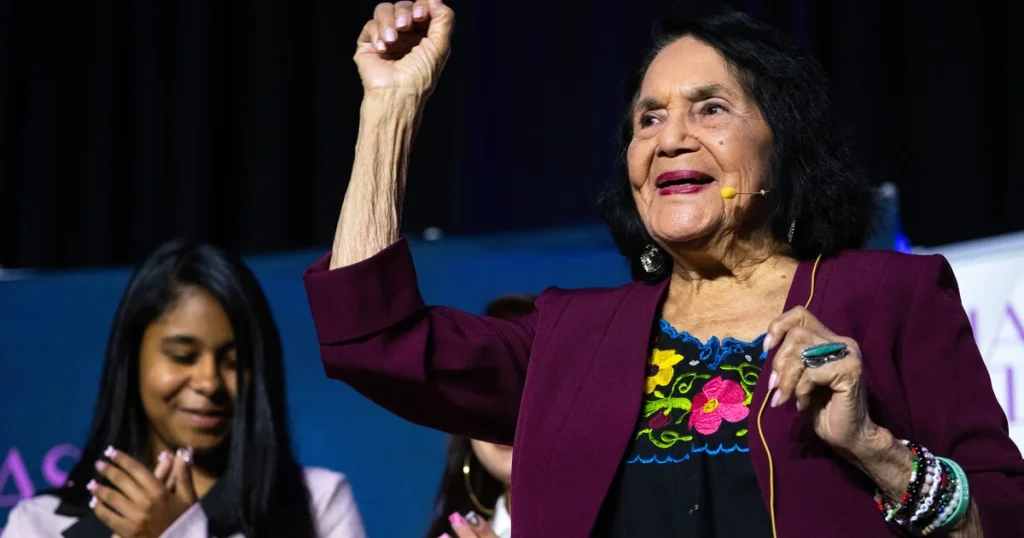
Dolores Huerta Calls Out Trump for Historical Misunderstanding
Labor activist Dolores Huerta says Trump – Dolores Huerta, a prominent labor activist, has criticized President Donald Trump for his lack of historical awareness in recent remarks about Mexican people. During a CBS News interview, Huerta highlighted how Trump’s comments echo long-standing prejudices against immigrants, particularly Mexicans, while neglecting the nation’s complex history. She argued that these statements are not just misguided but also a deliberate attempt to sow division, urging Latino communities in key states like California and Texas to leverage their political power in the 2024 elections.
A Pioneering Voice in Labor Movements
For decades, Huerta has been a driving force in advocating for workers’ rights and civil liberties. Her early work with the United Farm Workers (UFW) in the 1960s played a pivotal role in elevating the voices of agricultural laborers, many of whom endured harsh conditions and limited protections. This grassroots activism laid the foundation for her continued influence, as she remains a symbol of resilience and advocacy. Huerta’s efforts have not only shaped labor policies but also inspired movements that continue to address racial and economic inequality.
“When Trump first entered the political scene, he targeted Mexicans with rhetoric that ignores our shared history,” Huerta stated. “Texas was once a part of Mexico, and yet he acts as if we are strangers to this nation’s past.”
Her critique of Trump’s historical narratives is rooted in the president’s 2015 campaign speech, where he claimed, “Mexico is not sending their best,” blaming the country for sending “drugs, crime, and rapists.” Huerta emphasized that this line of thinking perpetuates stereotypes that have been used to dehumanize Mexican-Americans for generations. She stressed that understanding the historical context is essential for addressing modern challenges in immigration and labor policy.
From Grassroots to National Influence
While Huerta’s work spans labor rights, she has also made a lasting impact on political discourse. The phrase “si se puede,” which she popularized during a campaign in Arizona, has become a powerful mantra for marginalized communities. This Spanish slogan, translating to “yes, we can,” emerged as a response to opposition from local leaders who doubted the possibility of change. Huerta’s leadership transformed it into a rallying cry for empowerment and collective action, later adopted by Barack Obama’s 2008 campaign as “Yes, we can.”
“The power of ‘si se puede’ lies in its ability to unite people,” Huerta explained. “It’s not just about overcoming obstacles—it’s about reclaiming our place in the narrative.”
Her ability to bridge cultural and political divides has made her a key figure in mobilizing Latino voters. In Texas, where the demographic landscape is shifting, Huerta has called for unity among Latino communities to counter Republican strategies that aim to fragment their support. She believes that by uniting behind progressive candidates, Latino voters can reshape the political future of the state.
Political Challenges and Opportunities
The 2024 elections present a critical opportunity for Latino voters to assert their influence. In Texas, the Democratic convention showcased candidates like State Rep. James Talarico and Gina Hinojosa, who face strong Republican opponents in the Senate and governor’s race. Recent polls indicate a tight race between Talarico and Ken Paxton, with each securing 47% of the vote. Meanwhile, Hinojosa trails slightly behind Greg Abbott in the governor’s contest, but her campaign highlights the growing political clout of the Latino electorate.
Trump’s rhetoric, which has consistently framed Mexican immigrants as a burden, could resonate with certain voter groups. However, Huerta argues that this narrative overlooks the contributions of Mexican-Americans to the country’s development. She pointed to the history of labor movements, where Mexican workers have played a crucial role in shaping the American economy and culture. By addressing these historical facts, Huerta aims to counteract the divisive messaging that has fueled anti-immigrant sentiment.
Strategies of Division and the Path Forward
Republicans have sought to amplify Talarico’s progressive stance, labeling him as an outlier in Texas. Huerta dismissed these characterizations, calling them “ridiculous” and emphasizing that the Latino vote’s strength lies in its diversity. She noted that both Hinojosa and Xavier Becerra, the Democratic nominee for California governor, are Hispanic, reflecting the increasing representation of the community in leadership roles. Becerra’s candidacy, in particular, is seen as a testament to the potential for change in California’s political sphere.
Despite the challenges, Huerta remains optimistic about the power of informed advocacy. She urged voters to recognize the historical injustices faced by Mexican-Americans, arguing that these injustices are not confined to the past. By combining historical awareness with political action, she believes Latino communities can achieve lasting equity. Her message underscores the importance of education and solidarity in shaping the nation’s future.