
Meteor explodes off coast of Massachusetts, causing loud boom
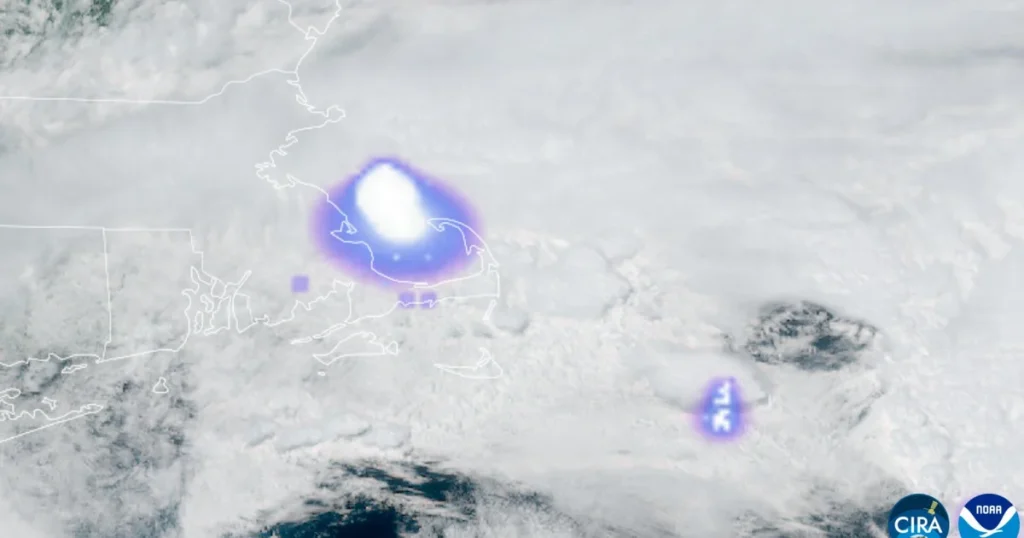
Massachusetts Coast Shaken by Meteor Explosion, Producing Thunderous Boom
Meteor explodes off coast of Massachusetts – On Saturday afternoon, a powerful meteor explosion occurred off the coast of Massachusetts, sending a resounding boom across the state. WBZ-TV chief meteorologist Eric Fisher confirmed the event, noting that the sound was reported around 2:11 p.m. Eastern Time. Residents described the sudden, thunderous noise as rattling windows, startling pets, and even shaking some houses. The newsroom received numerous calls detailing the loud blast, which was heard in areas ranging from Boston to Ipswich and Johnston, Rhode Island.
Preliminary Reports and Atmospheric Analysis
Preliminary reports submitted to the American Meteor Society indicated that many individuals across the Northeast witnessed the fireball around 2 p.m. Saturday. These sightings spanned multiple states, aiding scientists in reconstructing the meteor’s trajectory through the atmosphere. Satellite lightning data from the National Oceanic and Atmospheric Administration revealed a signature matching a meteor during the time the boom was reported. The data suggested that the meteor likely entered the atmosphere near Boston’s South Shore.
Understanding the Sonic Boom Phenomenon
“The meteor appears to have fragmented at an altitude of 40 miles over northeast Massachusetts and southeast New Hampshire. The energy released at breakup equates to roughly 300 tons of TNT, explaining the intense sound,” NASA said in a statement. Most meteors burn up harmlessly in the atmosphere, but larger objects can occasionally survive long enough to create the brilliant fireballs and booming shock waves that grab people’s attention.
Why do meteors produce such a dramatic sonic boom? Shauna Edson, from the Smithsonian National Space and Air Museum, explained to WBZ-TV that the noise is caused by air compression as the meteor travels at incredible speeds. She added that the meteor itself might also break apart due to the immense forces it encounters. “What you hear is the air compression of it moving really fast, creating those pressure waves, and occasionally sometimes you’re also hearing the stone itself break apart from the forces that it’s going through,” Edson said.
Atmospheric Path and Meteorite Recovery
The United States Geological Survey noted that sonic boom events differ from earthquakes in that they occur along a linear atmospheric path rather than a single point on Earth. Where did the meteor land? Edson mentioned that if it touched down off Massachusetts’ coast, it would be improbable to recover any remnants. She highlighted that most meteorites fall into the ocean because Earth is predominantly water.
Despite this, eyewitness accounts and video of the fireball can provide critical insights even without physical debris. Edson emphasized that the brightness, speed, angle of approach, and duration of visibility offer valuable data for analysis. “How bright it was, how fast it was moving, the angle it was coming from, and how long it stayed bright for, that gives us a lot of information,” she said.
Significance of Meteor Studies
Edson further stated that meteors serve as time capsules, carrying essential information about the solar system. When fragments are discovered, they become invaluable sources of knowledge, akin to treasures from space. “Meteors are the time capsules that carry information, so when we find pieces of them, each one is a treasure trove of information about the solar system,” she said.
She also noted that while meteorites are rare, there are a few places on the moon where we have retrieved moon rocks. However, the majority of space debris reaching Earth is delivered by nature, and its origins often remain a mystery.
Historical Case of a Human Impact
Has anyone ever been struck by a meteorite? Yes, in 1954, Ann Hodges of Sylacauga, Alabama, became the only known individual to be directly hit by a meteor. While resting on her couch, the space rock penetrated her roof, bounced off her radio, and landed on her thigh. Though she was unharmed, Hodges sustained significant bruising on her hip.
Edson explained that the likelihood of a meteor hitting a person is statistically low. “We as humans are very, very tiny part of a very big planet,” she said. “There’s not much you can do about it if it is going to happen, so live your life.”
Context of Recent Meteor Activity
Saturday’s incident marks the latest in a series of meteor sightings in 2026. While these occurrences are common, the combination of a loud boom and visible fireball makes this event particularly noteworthy. The phenomenon underscores the dynamic nature of Earth’s interactions with space objects, even as most meteors dissipate without leaving a trace. Scientists continue to study such events to better understand the mechanics of atmospheric entry and the potential risks posed by larger space debris.
Experts remain cautious about the implications of this explosion. Although the meteor fragmented high above the surface, its impact was felt far beyond the immediate area. The data collected from this event, along with others in the year, contributes to a broader understanding of meteor behavior. For instance, meteors traveling at speeds between 25,000 and 160,000 miles per hour generate immense energy, sometimes comparable to the detonation of thousands of pounds of explosives.
Edson’s comments also touched on the broader significance of meteors in space research. “Maybe it’s part of a broken-off piece of a lone asteroid. Maybe it’s just one of these smaller space things that’s been floating around that we don’t associate with something we know the name of,” she said. This unpredictability highlights the importance of ongoing observation and analysis, ensuring that even rare events like this one can yield valuable scientific insights.