
Putin Flexes Muscle with Test of Powerful Nuclear-Capable Missile
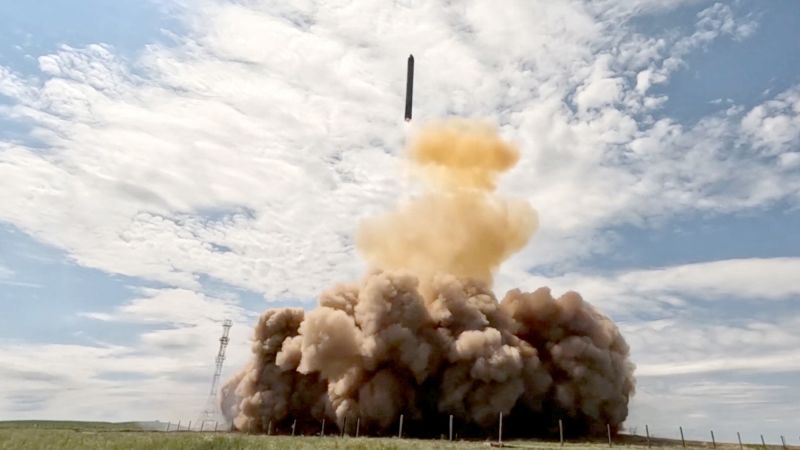
Putin flexes muscle with test of powerful – Russian President Vladimir Putin has asserted that the world’s most powerful missile system — referred to as “Satan II” by NATO — is now prepared for combat operations by the end of 2026, following a test launch that concluded successfully on Tuesday. The RS-28 Sarmat, a silo-launched intercontinental ballistic missile (ICBM), is projected to travel over 10,000 kilometers (6,200 miles) and potentially carry up to 16 independently targeted nuclear warheads, according to the Missile Defense Advocacy Alliance, a US-based non-profit organization. However, Putin emphasized that the missile’s actual range surpasses 35,000 kilometers (21,750 miles), positioning it as a formidable strategic asset.
The Sarmat’s development has been a long-awaited milestone for Russia, aiming to replace the aging SS-18 ICBM, which was first deployed under Soviet rule in the 1970s and labeled “Satan” by NATO. This new system, dubbed “Satan II,” has undergone a series of trials since its inception in 2011, though its progress has been marked by setbacks. The Center for Strategic and International Studies (CSIS) noted that the missile faced repeated challenges during testing, pushing back its initial deployment plan from 2018 to a later date. A notable failure occurred in September 2024, when a test at the Plesetsk Cosmodrome in the Arkhangelsk region left a crater measuring approximately 200 feet in diameter.
Despite these hurdles, Putin has consistently highlighted the Sarmat’s capabilities in public statements. “The combined yield of the payload is more than four times greater than that of any existing Western counterpart,” he stated, underscoring the missile’s strategic significance. The United States’ LGM-30 Minuteman ICBM, by contrast, has a range of around 11,000 kilometers (6,835 miles) and is currently equipped with a single warhead, though it was originally designed for three. The Sarmat’s ability to deliver multiple warheads makes it a key tool in Russia’s nuclear deterrence strategy, capable of overwhelming enemy defenses in a single strike.
Russian state television aired footage of Sergei Karakayev, commander of the Strategic Missile Forces, reporting to Putin on the “successful” test. This moment was framed as a demonstration of Russia’s military readiness and technological advancement. Yet, skepticism has emerged from within the country. The Telegram channel Astra, which has been designated a foreign agent by Russian authorities, questioned Putin’s repeated assurances about the missile’s readiness, noting he has made similar claims at least 10 times since 2021. Such doubts raise questions about the reliability of the system, especially given the recent test failure.
The Sarmat’s liquid-fueled design presents both advantages and disadvantages. While it allows for high thrust and flexibility in fuel composition, it also requires refueling shortly before launch, which can delay deployment compared to solid-fueled missiles. This characteristic has been a point of discussion among analysts, who highlight the logistical challenges it poses. Nonetheless, Russia maintains the world’s largest nuclear arsenal, with over 5,500 warheads in stock, as reported by the International Campaign to Abolish Nuclear Weapons. The United States, in comparison, holds just over 5,000 warheads, underscoring the strategic competition between the two nations.
Victory Day Parade Reflects Strategic Shift
The timing of the Sarmat test aligns with the Russian military’s Victory Day Parade, held on May 9, which commemorates the Soviet Union’s victory over Nazi Germany in World War II. This year’s event, however, marked a stark departure from previous years, with a notably subdued display of hardware. The parade was the most scaled-down since 2008, when Putin transformed it into an annual spectacle. For the first time in nearly two decades, no military equipment was showcased, reflecting a shift in priorities amid heightened security concerns.
Russian authorities cited threats from Ukrainian strikes as the reason for the pared-down event. These attacks, particularly on oil refineries, had penetrated deep into Russian territory, prompting the government to reduce the scale of the parade. Putin, in an interview with journalists, explained the decision by stating that the armed forces should focus on “the decisive defeat of the enemy” in the “special military operation” in Ukraine. Instead of traditional military displays, giant screens in Moscow’s Red Square broadcast pre-produced videos depicting frontline activities, offering a virtual glimpse of the war effort.
Amid this backdrop, Putin’s personal activities were also highlighted. On Monday, the Kremlin released footage of him visiting a hotel in Moscow to personally pick up Vera Gurevich, a former schoolteacher, for dinner. The encounter, which included a bouquet of flowers and a warm embrace, was presented as a gesture of humility and connection to civilian life. Gurevich, who had been invited to attend the Victory Day Parade, spent several days in the capital, underscoring Putin’s efforts to balance military and public narratives.
While the parade and test launch serve as symbolic tools, they also reflect a broader strategic communication campaign. The Kremlin has dismissed a European intelligence report, obtained by CNN and other outlets, which suggested that Putin’s security has been significantly bolstered. The report claims that the president now enjoys heightened protection and travels to fewer locations, indicating a shift toward more cautious public appearances. This move coincides with the Sarmat’s recent testing, signaling a dual focus on both military capability and political messaging.
The Sarmat’s success, if confirmed, would mark a major leap in Russia’s nuclear arsenal. With its extended range and multiple warhead capacity, the missile could target enemies across continents, reinforcing Moscow’s position as a global power. However, the recent test failure and ongoing skepticism highlight the challenges in achieving operational perfection. As the world watches Russia’s progress, the interplay between military advancements and political theater continues to shape the narrative of its strategic ambitions.
Brad Lendon, the reporter for this article, was based in Seoul, where he covered international developments and their implications for global security. His work underscores the interconnected nature of military and diplomatic strategies, particularly in the context of evolving tensions between Russia and its adversaries. The Sarmat test, coupled with the Victory Day Parade, serves as a reminder of the multifaceted approach Russia employs to assert its influence on the world stage.
In summary, the Sarmat’s test represents not only a technical achievement but also a strategic statement. It aligns with the broader narrative of Russia’s military modernization and its desire to project strength, even as it navigates challenges in both testing and public perception. The event’s timing, following a scaled-back parade, further emphasizes the importance of consolidating military and political messages in a rapidly changing global landscape.





