
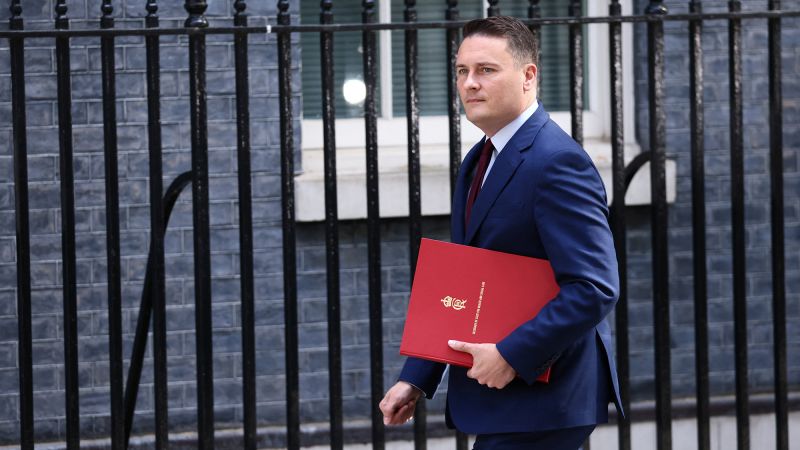
Wes Streeting Resigns as Health Secretary, Challenges Keir Starmer’s Leadership
Leading challenger to UK Prime Minister – Wes Streeting, the UK’s Health Secretary, has stepped down from his role, citing a decline in confidence in Prime Minister Keir Starmer’s leadership. His decision, announced Thursday, emphasized that remaining in the government would be “dishonourable and unprincipled” given the perceived lack of direction. This marks the first resignation from Starmer’s cabinet since a recent wave of dissent within the Labour Party began following poor electoral performance in England, Scotland, and Wales.
The Political Tectonic Shift
The resignation of Streeting, a prominent figure in Labour’s leadership race, has intensified speculation about the party’s internal turmoil. While he did not formally declare a bid to replace Starmer, his move signals a potential challenge. To initiate a leadership contest, Streeting needs backing from 81 Labour MPs, representing one fifth of the party’s parliamentary membership. His departure has added fuel to the growing unrest, with nearly 90 lawmakers already advocating for Starmer’s resignation.
Streeting’s exit follows a string of setbacks for the Labour Party, including a resounding defeat in local elections that has shaken its base. He argued that these results exposed a fracture in the party’s unity, with “nationalists in power in every corner” of the country—a reference to Reform UK’s success under Nigel Farage and the rise of regional nationalist parties. This, he claimed, could jeopardize the UK’s cohesion, a concern he has echoed in previous statements.
Reforms and the NHS: A Mixed Legacy
Despite the political fallout, Streeting’s tenure as Health Secretary has yielded measurable progress in the National Health Service (NHS). Government data released Thursday showed a record 110,000 fewer patients on waiting lists in March, the largest monthly decline since the early days of the pandemic. This success, he noted, positions the NHS on track for the fastest improvement in waiting times in history. Yet, his departure raises questions about whether these achievements will be enough to sustain Labour’s appeal among progressive voters.
Streeting has long championed modernization of the NHS, a project he inherited from a deeply divided party. His strategy to overhaul the system, which has consumed an increasing share of the UK’s GDP, has faced criticism but also praise. His allies highlight his ability to communicate complex ideas with clarity and energy, traits that have helped counterbalance the government’s struggles to articulate its vision. However, opponents argue that his ambitions have sometimes overshadowed the party’s core principles.
A Leader from the Right of the Labour Party
Streeting’s political journey is deeply rooted in Labour’s traditional strongholds. He began his career as president of the National Union of Students, later serving as a local councillor, and now represents a borough in East London where he grew up. This background has shaped his approach to governance, blending pragmatic policies with a commitment to social justice. While he has supported Labour’s progressive agenda, his alignment with Blairism—echoed in his rhetoric about the NHS—has drawn attention from both within and outside the party.
His relationship with Tony Blair’s era of leadership remains a point of discussion. Though he briefly left Labour in 2003 over Blair’s Iraq War stance, he later reconciled with the party, adopting elements of Blair’s political style. This compromise has allowed him to navigate Labour’s internal debates while maintaining a centrist image. However, some critics see this as a sign of his willingness to prioritize personal advancement over ideological consistency.
The Leadership Controversy: Starmer’s Resilience and the Rivals
Starmer, who came to power in 2024 after a landslide election, has defended his leadership against growing scrutiny. In a speech earlier this week, he rejected calls for resignation, warning that a leadership change would plunge the country back into the chaos of the Conservative era. His critics, however, point to the recent election results as evidence of his weakening grip on the party.
While Streeting’s resignation hasn’t yet triggered a formal leadership contest, it has positioned him as a key contender. His role as a bridge between Labour’s left and right has made him a compelling figure, though his focus on policy over party loyalty has drawn mixed reactions. Meanwhile, former Deputy Prime Minister Angela Rayner, who recently resolved a property tax scandal, is also seen as a potential rival. Rayner, however, leans more to Labour’s centrist wing, contrasting with Streeting’s alignment with the right.
The Road Ahead: A Battle of Ideas or Personalities?
Streeting framed his resignation as a desire to ensure the next Labour leadership contest becomes a “battle of ideas,” not a contest of personalities. He called for a broad and inclusive debate, emphasizing that the party must present a united front to secure victory in the 2029 general election. His vision for Labour includes a balance between progressive values and practical governance, a stance he believes has been undermined by recent missteps.
Downing Street, Starmer’s headquarters, has remained silent on Streeting’s exit, but it has consistently denied any intention of stepping down. This has fueled debate about the true extent of the leadership crisis. While some see Streeting’s resignation as a precursor to a larger challenge, others argue it is a tactical move to test the waters. Regardless, his departure has left a void in the Labour government, raising the stakes for the party’s future.
Back to the Roots: A Leader Shaped by Labour’s History
Streeting’s political career has been defined by his connection to Labour’s working-class roots. His constituency in East London, where he grew up in a public housing estate, has been a cornerstone of his appeal. This grassroots foundation has often been contrasted with the more metropolitan image of Starmer, who represents the party’s modern, centrist face.
His recent electoral victory—clinging to his parliamentary seat by just 528 votes—underscores the thin margin of support Labour faces. This has made Streeting’s position all the more significant, as his departure could signal a broader shift in the party’s direction. Supporters view him as a unifier, capable of articulating Labour’s vision with both clarity and conviction. Detractors, however, argue that his focus on individual prominence has come at the expense of collective goals.
The Ripple Effect: What Comes Next?
As the Labour Party grapples with internal divisions, Streeting’s resignation has become a symbolic moment. It has highlighted the tension between reform and tradition, ambition and principle. His departure, coupled with Rayner’s recent resolution of a personal scandal, suggests a dynamic political landscape where multiple voices are vying to shape Labour’s future.
For now, the focus remains on whether Starmer will remain unchallenged. His allies insist that the recent data on NHS improvements and the party’s overall strategy demonstrate stability. Yet, the resignation of a key cabinet member signals that the path to 2029 will not be easy. As the debate intensifies, the Labour Party faces a critical juncture—one that could redefine its identity and direction for years to come.
Conclusion: A Leadership Test for Labour
Streeting’s exit from the government has cast a spotlight on Labour’s leadership challenges. While his reasons for leaving are rooted in a belief that the party has lost its way, the broader implications of his decision will be felt in the months ahead. The Labour Party now must reconcile its past and future, ensuring that the next chapter of its history is written with both vision and unity. As the dust settles, the question remains: will this be the start of a new era or a continuation of an existing struggle?





