
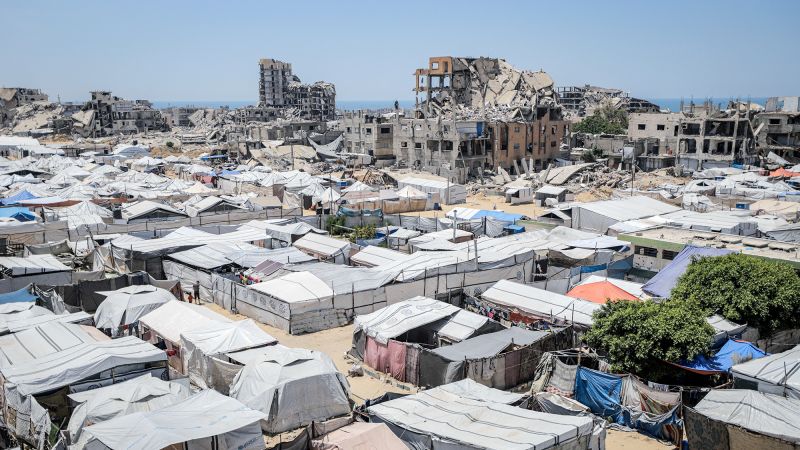
Gaza Risks Becoming Permanently Divided, Top Official Warns
Gaza risks becoming permanently divided top official – As the conflict in Gaza enters a critical phase, international leaders are sounding alarms about the possibility of the territory being split indefinitely. A senior official from the Gaza Board of Peace (BoP), Nikolay Mladenov, has raised concerns that without decisive progress on the ceasefire, the current division could become permanent. Speaking during a press conference in Jerusalem on Wednesday, Mladenov emphasized that the situation demands immediate action to prevent a lasting separation of Gaza’s population and territory.
The Ceasefire’s Unsteady Progress
The October 2025 ceasefire agreement between Israel and Hamas was intended to bring stability, but Mladenov acknowledges it remains incomplete. “The truce is far from perfect,” he stated, highlighting ongoing challenges that threaten its effectiveness. Despite the agreement’s framework, the ceasefire has not fully addressed the concerns of either side, leaving the region in a state of flux.
Under the deal, Israeli forces were supposed to withdraw to the “yellow line,” a demarcation that initially covered 53% of Gaza. However, recent satellite imagery has revealed a significant shift. The Israeli military has shared a new map marking the “orange line,” which now extends further into the territory, giving Israel control over approximately 64% of the area. This expansion has tightened the grip of Israeli forces on the enclave, compressing the population into a narrowing strip of land.
“A status quo should not be an option to anyone,” said Mladenov, who serves as the director-general of the Gaza Board of Peace. “The longer we don’t address the future, the more we stabilize the status quo, and that status quo becomes more difficult to remove.”
While the BoP and international mediators—comprising the United States, Egypt, Qatar, and Turkey—continue to monitor compliance, Mladenov warns that the current arrangement is not sustainable. He described the situation as a “dangerous status quo,” which risks trapping two million Palestinians in a state of perpetual uncertainty. “Without progress, Gaza could lose its viability as a unified entity,” he added, stressing the importance of resolving the division before it solidifies.
Shifting Control and Escalating Tensions
The Israeli military has been actively expanding its presence in Gaza, even as the ceasefire agreement was meant to reduce hostilities. Recent reports indicate that hundreds of Palestinians have been killed, with Israeli airstrikes occurring nearly daily. According to the Palestinian Ministry of Health, over 850 lives have been lost since the ceasefire took effect, underscoring the continued violence despite the truce.
Mladenov pointed out that the Israeli forces are not only reinforcing their control but also reshaping the geographical boundaries of the enclave. He cautioned that the “yellow line” could eventually transform into a permanent barrier, effectively dividing Gaza. “At that point, it doesn’t really matter where the yellow line is, but Gaza is gone,” he said, implying that the territory’s unity could be irreversibly compromised.
Meanwhile, Hamas has not fully disarmed as required by the ceasefire deal. Israeli officials claim the group is regrouping, rebuilding its military and civilian infrastructure to maintain its grip on the region. This ongoing activity has raised fears that the ceasefire might not hold, with Mladenov warning that Hamas’ rearmament could lead to renewed threats against Israel’s security.
A 50-Point Plan for Gaza’s Future
Despite the challenges, Mladenov remains optimistic about the 20-point peace plan brokered by the United States. He described it as a breakthrough that “opened the door for the future,” envisioning a Gaza that could see wide-scale reconstruction, a full Israeli withdrawal, and the creation of a new Palestinian governing body. The plan has since been expanded into a 50-point implementation document, developed in collaboration with the BoP and mediators, and reviewed by both Israel and Hamas.
“Each step by one side triggers the next step by the other side. If a step is missed, the next step does not happen,” Mladenov explained. This principle of reciprocity is central to the plan, which Mladenov insists is not based on trust but on mutual accountability. An independent verification mechanism has been established to ensure compliance, but the success of the plan hinges on Hamas’ willingness to disarm and cede governance to a civilian authority.
The most contentious element of the agreement, Hamas’ disarmament, remains a major obstacle. Mladenov stated that Israel’s complete withdrawal from Gaza depends on Hamas fulfilling its part of the deal, including decommissioning weapons and establishing civil governance. “The plan is clear: Hamas needs to step back from governance of Gaza, its weapons need to be decommissioned, and Gaza must be deradicalized,” he emphasized. Without this progress, he argued, the ceasefire’s long-term viability is in question.
Global Attention and Local Struggles
The current crisis in Gaza has been exacerbated by global focus on the war in Iran. While the international community has been preoccupied with developments in Tehran, the situation in Gaza has continued to deteriorate. Mladenov noted that the ceasefire has not halted the Israeli military’s operations, with air strikes and ground movements still constituting violations of the agreement.
“There are a lot of things happening on the ground,” he said, referring to the ongoing violence that has left civilians in fear. The Palestinian Ministry of Health reports that the conflict has not yet ended for many in Gaza, with families enduring the trauma of repeated attacks. Mladenov acknowledged that the ceasefire has brought “relative stability” but stressed that this stability is fragile and requires sustained efforts to maintain.
As the international community debates the future of Gaza, Mladenov’s warning serves as a reminder of the stakes involved. The division of the territory could have far-reaching consequences, not only for the Palestinians but also for Israel’s security and the region’s political landscape. With the clock ticking and the situation growing more complex, the challenge remains to bridge the gap between the two sides before the ceasefire becomes a permanent arrangement.





