
Protests and Defeat: Chelsea Fans Lose Patience with Billionaire American Ownership
Protests and defeat – Four years into the tenure of Todd Boehly, the American billionaire who purchased Chelsea in May 2022, the once-dominant football club now finds itself in a state of discontent. Boehly, alongside his consortium, BlueCo, had promised a bold vision for the club, declaring, “We’re all in – 100%,” during his first public address to fans. Yet, as the season progresses, the BlueCo ownership faces mounting criticism, with their initiatives seemingly failing to deliver the stability and success Chelsea supporters once expected. The culmination of this frustration came to light on Saturday, when the team’s FA Cup final loss to Manchester City left fans in despair, marking a stark contrast to the optimism Boehly once inspired.
The Unraveling of a Promising Vision
Boehly’s arrival was heralded as a transformative moment for Chelsea, a club that had long been a symbol of Premier League dominance. The consortium’s promises of financial firepower and long-term success were met with enthusiasm, but the reality has been far less satisfying. The club’s current standings in the league, languishing in ninth place, reflect a clear decline in performance. This is particularly jarring for a team that has historically been a powerhouse, leaving fans to question whether the new ownership has prioritized short-term gains over sustained excellence.
The FA Cup final, while offering a glimmer of hope, ultimately underscored the broader issues plaguing Chelsea. Despite a valiant run to the final, the team’s inability to secure a victory against Manchester City highlighted a lack of quality and cohesion. Fans, who had endured a frustrating season of inconsistent results, were left disillusioned. The match at Wembley became a microcosm of their collective mood, with dejected expressions and murmurs of disappointment echoing through the stadium.
A Fanbase in Turmoil
Chelsea’s fanbase, known for its unwavering loyalty and high expectations, has grown increasingly restless. The pressure to perform has intensified since Boehly’s takeover, as the club’s global stature demands a consistent presence in top-tier competitions. However, recent performances have been a source of embarrassment, with the team failing to win in seven consecutive league games. This has forced fans to confront a harsh reality: the club’s ambitions may have outpaced its execution.
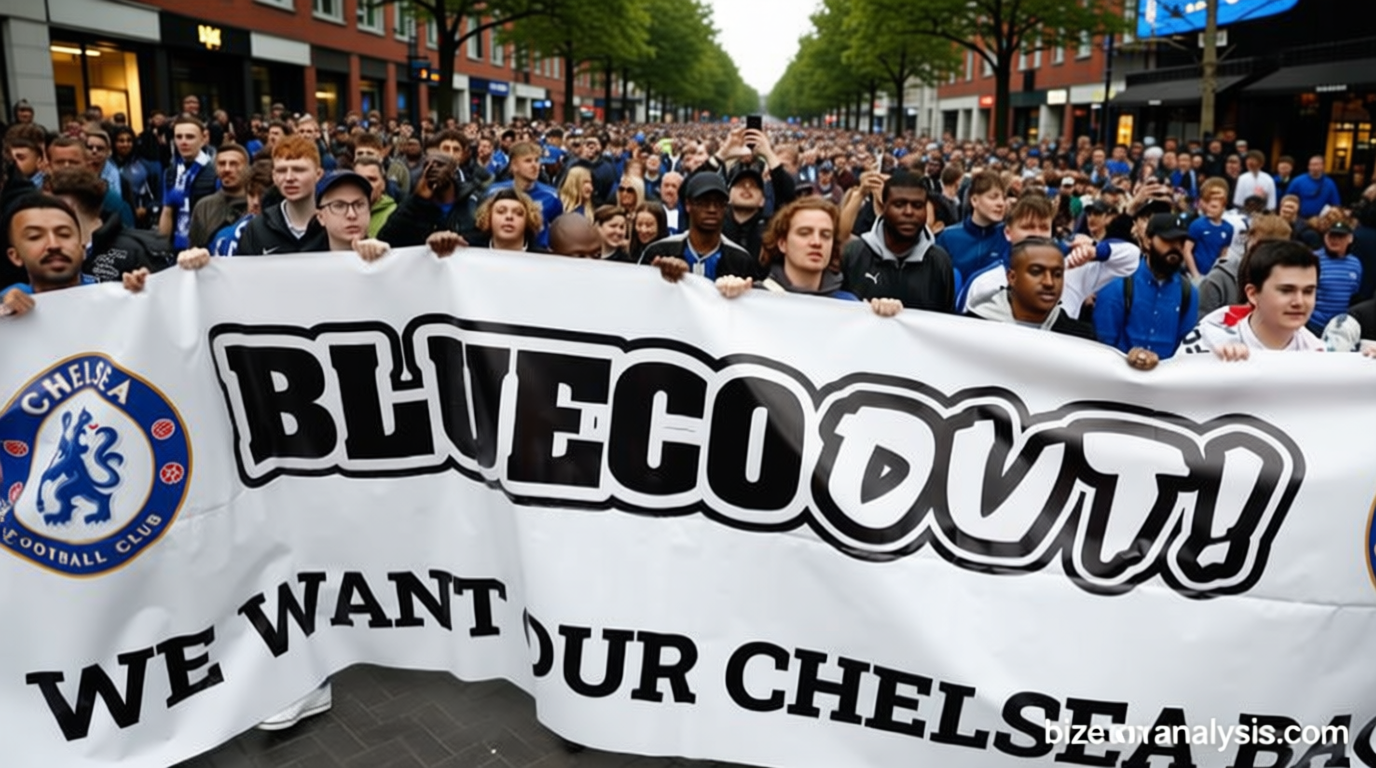
Before the FA Cup final, a protest against BlueCo took place along Wembley Way, with supporters carrying banners that read, “BlueCo out! We want our Chelsea back.” The demonstration symbolized the growing rift between the club and its supporters, who feel disconnected from the team’s direction. One fan, on the tube heading to the stadium, expressed their skepticism: “I think we’re going to get smashed.” His friend nodded in agreement, stating, “I think you’re probably right.” Their exchange, lighthearted yet revealing, captured the general sentiment of the crowd, who had grown weary of the season’s unraveling.
The Financial Gamble and Squad Overload
While Boehly’s investment has been substantial, it has not translated into the desired results. The club has spent over $1 billion on player transfers since the takeover, yet the squad remains bloated and lacks the experience and leadership that define successful teams. The strategy of signing young talents to long contracts, with the intention of selling them for profit, has backfired. Instead of creating a cohesive unit, it has led to an overstaffed roster where individual brilliance often overshadows team synergy.
Even the most loyal supporters, who have weathered decades of highs and lows, are now vocal in their criticism. The recent loss to Manchester City in the FA Cup final was the final straw, reinforcing the belief that the club has lost its identity. The players, despite their efforts, were unable to overcome the gulf in quality between themselves and their rivals. This discrepancy raises questions about how the ownership has allocated resources and whether their focus on financial gains has come at the expense of tactical and cultural cohesion.
Managerial Instability and Leadership Vacuum
The managerial situation has also contributed to the club’s struggles. Calum McFarlane, who led Chelsea in the FA Cup final, serves as an interim coach, a role that underscores the uncertainty surrounding the club’s leadership. McFarlane’s presence is a temporary fix, with the real challenge lying in securing a permanent solution. The turnover of managers under Boehly’s ownership has been relentless, with each departure sparking new concerns.
Enzo Maresca, the former coach who guided Chelsea to the FIFA Club World Cup last year, was dismissed in January, citing his inability to adapt to the current management style. Before him, Liam Rosenior, who had been poached from Strasbourg, also faced a short tenure. These exits have left fans questioning the decision-making process and the long-term vision of the ownership. With no clear direction, the club has struggled to maintain consistency, further eroding fan confidence.
The Road Ahead for Chelsea
Despite the current challenges, Chelsea’s future remains uncertain but not without hope. The club officially announced Xabi Alonso as its new manager on Sunday, with the former Bayer Leverkusen and Real Madrid boss set to take charge on July 1. Alonso’s appointment is seen as a pivotal moment, one that could signal a shift in strategy and a renewed focus on rebuilding the team’s foundation. However, the task ahead is formidable, requiring not only tactical adjustments but also a reconnection with the fanbase that once celebrated the club’s success.
The relationship between the ownership and the supporters has deteriorated significantly. A recent moment of tension occurred when the team gave a solemn applause to the fans at full-time, a gesture that felt more like an acknowledgment of failure than a sign of unity. This disconnect has fueled the protests and reinforced the perception that the new owners are out of touch with the club’s heritage and the expectations of its fans. The question now is whether Alonso can restore faith or if the next chapter will simply mirror the current one in disappointment.
As the season concludes, the focus shifts to the future. Boehly’s legacy is now tied to the club’s decline, with fans demanding accountability and a return to the standards that once defined Chelsea. The investment of over $1 billion has not yielded the results promised, and the management’s decisions continue to be scrutinized. For a club with such a storied history, the challenge is to not only rebuild its squad but also its reputation. The FA Cup final may have been a setback, but it serves as a reminder of the high stakes and the need for decisive action. The fans, once hopeful, now await a clear plan to reclaim their beloved team’s former glory.





