
Record haul of rare Yuan Dynasty blue-and-white porcelain discovered at shipwreck off Singapore
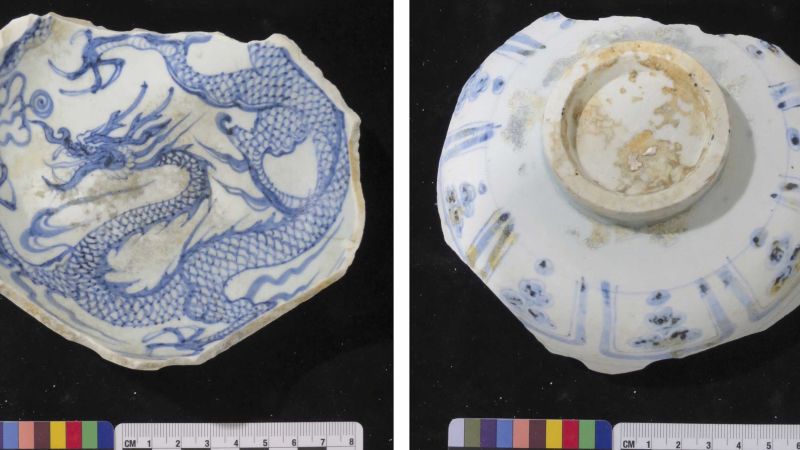
Record haul of rare Yuan Dynasty blue-and-white porcelain discovered at shipwreck off Singapore
Discovery Details
A significant shipwreck off Singapore’s coast has revealed an extensive collection of blue-and-white porcelain, offering new insights into a pivotal era of Chinese craftsmanship. The vessel, estimated to be over 600 years old, was believed to have traveled from China to Temasek, an ancient settlement now part of modern Singapore. According to a study detailing the find, the wreck contained a record number of Yuan Dynasty ceramics, including fragments and a few intact items.
Challenges in Recovery
Marine archaeologist Michael Flecker and his team spent four years meticulously exploring the 14th-century site, overcoming formidable obstacles. Despite the relatively shallow depth, strong currents and poor visibility made diving difficult, allowing only one expedition every four weeks. Flecker described the conditions as perilous, recounting instances of divers being thrown against the seabed or struggling to navigate back to safety in darkness.
Designs and Dating Clues
Among the recovered shards, distinctive patterns emerged, such as a four-clawed dragon and a phoenix framed by chrysanthemums. A recurring motif of mandarin ducks in a lotus pond provided critical clues for dating the wreck. This design was favored by Emperor Wenzong during his reign from 1328 to 1332, though its popularity likely surged after his overthrow, leading to increased production by commercial kilns.
“Even then, we were occasionally sent tumbling along the seabed or groping our way back to the diver down-line in darkness,” said Flecker, a senior archaeologist at Heritage SG, a subsidiary of the Singapore National Heritage Board.
Trade Networks and Artistic Influence
The porcelain highlights the interconnectedness of trade routes during the Mongol Empire’s dominance. Crafted by Chinese artisans and using cobalt sourced from Persia, the ceramics were transported via land and sea networks, underscoring the era’s global reach. Shane McCausland, a professor of art history at SOAS University of London, noted that Yuan porcelain marked a transformative moment in Chinese artistic innovation, challenging traditional views of the dynasty’s contributions.
“This is crockery, it’s not prized in the same way as gold, painting, calligraphy or the greatest architecture,” McCausland remarked. “Yet, it’s something to do with the translucency, the incredible hardness of it, it’s a kind of material that is a bit miraculous.”
Mongol Legacy in Chinese Art
Flecker suggested the ship was a Chinese junk, a common sailing vessel of the early Middle Ages. He explained that the loss of imperial kiln knowledge after the Mongols left China in 1368 led to a decline in Yuan-style blue-and-white production. The study estimates the wreck dates between the late 1320s and 1371, a span influenced by the fall of the Yuan Dynasty and the Ming emperor’s restrictions on trade.
“As soon as the Mongols retreated from China in 1368, the knowledge that this blue-and-white was a breakthrough of the Yuan period got lost,” Flecker stated.
Additional Insights
Meanwhile, a separate archaeological find in China has sparked debate about human evolutionary timelines, as noted by scientists. The porcelain’s discovery further enriches our understanding of the Mongol Empire’s role in fostering cross-cultural exchanges and artistic advancements.
