
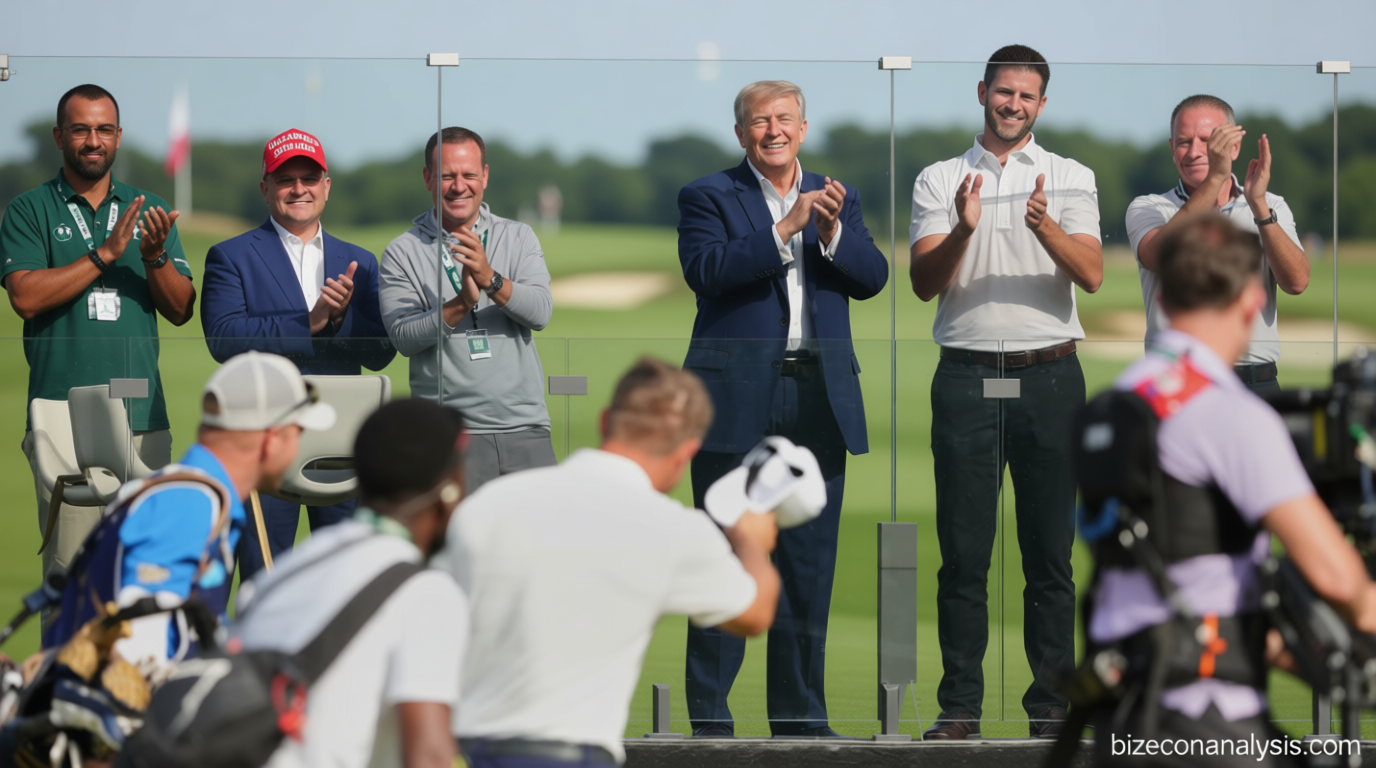
Trump’s Role as LIV Golf Host Sparks Renewed Debate on Ethical Concerns
Trump s role as LIV Golf – Recent events have reignited discussions about potential conflicts of interest involving President Donald Trump, particularly after he hosted a LIV Golf event at his Virginia estate last weekend. The gathering, which drew attention for its blend of political and commercial activities, has prompted analysts to scrutinize whether the Trump family is profiting from his presidency while aligning with a golf league backed by a government under international criticism. The Saudi Arabian monarchy, a key financial supporter of LIV, has long faced allegations of human rights violations, and its decision to end funding for the league after the 2026 season has not diminished the controversy surrounding its involvement.
The LIV Golf Connection
For years, Trump’s golf courses have been central to the league’s operations, serving as both a venue and a symbol of its global ambitions. The league, which has drawn significant backlash for its ties to Saudi Arabia, has been accused of using high-profile sporting events to distract from the kingdom’s human rights record. Critics argue that Trump’s association with LIV Golf, through hosting events at his properties, creates a situation where his political decisions may be influenced by financial interests tied to the Saudi government. This has raised questions about transparency and the potential for personal gain at the expense of public trust.
The Saudi Arabian government has been a major backer of LIV, with its Public Investment Fund (PIF) investing heavily in sports as part of a broader strategy to enhance its international image. In addition to supporting the golf league, the PIF has also poured resources into soccer, securing deals with global stars and acquiring an English team. These initiatives, collectively termed “sportswashing,” are seen as efforts to project a more favorable perception of Saudi Arabia, particularly after the 2018 murder of Jamal Khashoggi, a prominent Saudi journalist who was critical of the regime. The PIF’s involvement in LIV has been framed as a way to divert attention from such controversies.
Trump’s Stance on Saudi Human Rights
During a high-profile meeting with Saudi Crown Prince Mohammed bin Salman at the White House last year, Trump dismissed concerns about Khashoggi’s killing, labeling the journalist as “extremely controversial.” The president insisted that the incident was used to embarrass the crown prince and claimed that bin Salman had no knowledge of the event. This stance has drawn sharp criticism from ethics experts, who argue that Trump’s actions reflect a prioritization of business relationships over moral accountability. “Saudi Arabia is a murderous, authoritarian, anti-democratic regime,” said Kathleen Clark, a law professor specializing in government ethics at Washington University in St. Louis. “(Trump’s) willingness to do this is actually a really nice example about what his priorities are.”
The Saudi Foreign Ministry has consistently denied the allegations, stating in 2021 that the kingdom “completely rejects the negative, false and unacceptable assessment in the report pertaining to the Kingdom’s leadership.” It emphasized that the report contained “inaccurate information and conclusions.” Despite these denials, the connection between the Saudi government and LIV Golf has remained a focal point for critics, who view the league as a tool for political propaganda. The recent hosting of LIV events by Trump has further intensified this scrutiny, particularly given his personal history of leveraging his business empire for political advantage.
Transparency and Financial Interests
Trump’s hosting of LIV Golf events at his properties has sparked concerns about the transparency of his financial dealings. While the president has claimed that his assets are managed by a trust controlled by his children and that he avoids direct involvement in business during his time in office, experts argue that the arrangement allows for significant financial benefits. “There is little transparency around how much financial compensation his family is obtaining,” noted one analyst. “This creates an opportunity for conflicts of interest that could influence policy decisions.”
Trump’s participation in golf events at his courses, including last week’s PGA Tour stop in Doral, Florida, and the recent LIV event in Sterling, Virginia, has been seen as part of a larger pattern of intertwining business and politics. His public endorsements of Saudi Arabia’s sporting investments, such as the 10-year Formula 1 partnership, have also drawn attention. These activities, combined with his acceptance of a $400 million luxury jet from Qatar and his promotion of cryptocurrency ventures, highlight the potential for personal and political interests to overlap. “This is just going to be the tip of the iceberg,” said Richard Painter, a professor of corporate law at the University of Minnesota Law School. “The message has been said all over the world that if you want to get along with the Trump administration, do business with the Trump family or their golf courses.”
The controversy extends beyond golf tournaments. Critics have pointed to Trump’s tendency to blur the lines between public service and private profit, arguing that his administration’s decisions may be swayed by corporate interests. For instance, the acceptance of the Qatar jet and the support for Saudi sports initiatives are seen as examples of how the Trump family could indirectly benefit from their ties to foreign governments. These actions have fueled debates about whether the president’s policies are driven by genuine national interests or by financial incentives tied to his business ventures.
Broader Implications for Ethical Standards
Analysts emphasize that the issue is not merely about Trump’s association with LIV Golf but about the broader implications for ethical standards in governance. The Trump family’s ownership of the golf courses and their active role in hosting events raises questions about the independence of the presidency. “When a leader’s private interests are closely tied to their public duties, it can create a perception of bias,” said one ethics expert. “This is especially concerning when the leader is supporting entities that have been accused of serious human rights violations.”
The ongoing scrutiny underscores the challenges of maintaining transparency in a presidency where business and political activities are frequently intertwined. While the White House has defended Trump’s actions, stating that his assets are managed independently, critics remain skeptical. “President Trump’s assets are in a trust managed by his children,” White House spokeswoman Anna Kelly told CNN last year. “There are no conflicts of interest.” However, the evidence suggests that the potential for conflicts remains significant, particularly given the Saudi government’s history of human rights abuses and its financial stake in the golf league.
As the Trump administration continues its second term, the focus on conflicts of interest is likely to persist. The combination of high-profile sporting events, corporate partnerships, and political diplomacy has created a complex web of relationships that may influence decision-making. The debate over whether these ties are beneficial or detrimental to the public interest remains unresolved, with experts calling for greater oversight and disclosure to ensure accountability.
Meanwhile, the Saudi Arabian government has maintained its position that the accusations against it are unfounded, insisting that its investments in sports are part of a broader vision for global engagement. However, the continued support for LIV Golf and other initiatives has kept the conversation alive, highlighting the need for vigilance in monitoring the intersection of politics and commerce in the Trump administration.





